
AI Stenography vs Human Stenographer: Which Fits?
On this pageSection guide
AI stenography vs human stenographer at a glance
| Decision factor | AI stenography | Human stenographer | Hybrid workflow |
|---|---|---|---|
| Best fit | Scalable live captions and searchable drafts | Official, certified, regulated, or high-consequence capture | Live scale with planned human control |
| Context | Infers words from audio and supplied terminology | Applies trained judgement and can follow assignment protocols | Human prioritises uncertain or consequential passages |
| Languages | Can extend suitable multilingual event access | Depends on qualified professional availability | Automation covers reach while people protect critical output |
| Corrections | May revise provisional text as context arrives | Can clarify, correct, and maintain the assigned record | Live monitoring plus post-session review |
| Output status | Draft or access text unless a governing process says otherwise | May create the required record when properly appointed | Status depends on the agreed reviewer and process |
Choose the record before choosing the technology
Start by naming the output: live access, rough notes, a searchable draft, an edited transcript, a certified record, or captions for a named accommodation. These outputs carry different responsibilities. A tool that is appropriate for conference notes may be inappropriate for sworn testimony, medical instructions, a formal inquiry, or an individual accessibility plan.
NCRA's current AI position treats automatic speech recognition as a supplemental tool and states that it cannot replace a trained, certified, impartial human court reporter or captioner in creating, preserving, and certifying the official record. That is a professional-association position, not a universal law, but it defines an important procurement boundary. Read the NCRA AI position statement.
When AI stenography is the stronger fit
- Conferences and town halls need immediate captions across multiple rooms or audience devices.
- Teams need a searchable draft soon after a meeting, interview, workshop, or webinar.
- Event organisers need source text that can feed configured caption or language outputs.
- The alternative is no live text, and the limitations have been tested and communicated.
- Human review can be targeted at names, numbers, decisions, quotations, and published passages.
AI performance is conditional. Microphone distance, reverberation, crosstalk, compressed remote audio, language switching, accents, names, and technical vocabulary can all change the result. Representative rehearsal is more useful than a vendor's context-free percentage.
When a human stenographer is the stronger fit
- A court, tribunal, regulator, institution, or contract specifies a qualified professional.
- The session requires read-back, speaker clarification, controlled exhibits, or formal certification.
- The record is evidentiary, confidential, medical, legal, or otherwise high consequence.
- A Deaf or hard-of-hearing participant has an accommodation that calls for professional CART.
- The buyer needs a person who is accountable for the capture and correction process.
The U.S. Bureau of Labor Statistics describes court reporters as responsible for complete, accurate, and secure legal transcripts. It also distinguishes simultaneous captioners, who provide realtime text in meetings, broadcasts, classes, and public settings. See the BLS role and duties.
Accessibility requires more than words on a screen
W3C defines captions as synchronized text alternatives for speech and the non-speech audio needed to understand media. Speaker identity, meaningful sounds, completeness, timing, and readability matter alongside word recognition. Review the W3C guidance for live captions and confirm the needs of the person receiving the accommodation.
Use a hybrid workflow when speed and accountability overlap
- Define risk. Mark names, numbers, decisions, evidence, instructions, and public quotations as priority text.
- Prepare context. Supply agendas, speaker names, acronyms, specialist terms, and expected languages.
- Test the full path. Rehearse microphones, mixer feeds, room acoustics, network delivery, and displays.
- Assign ownership. Name who monitors the session, corrects the draft, approves publication, and deletes retained data.
- Label the output. Do not present provisional AI text as certified, final, or official unless the applicable process makes it so.
How Pikka Speech supports AI stenography
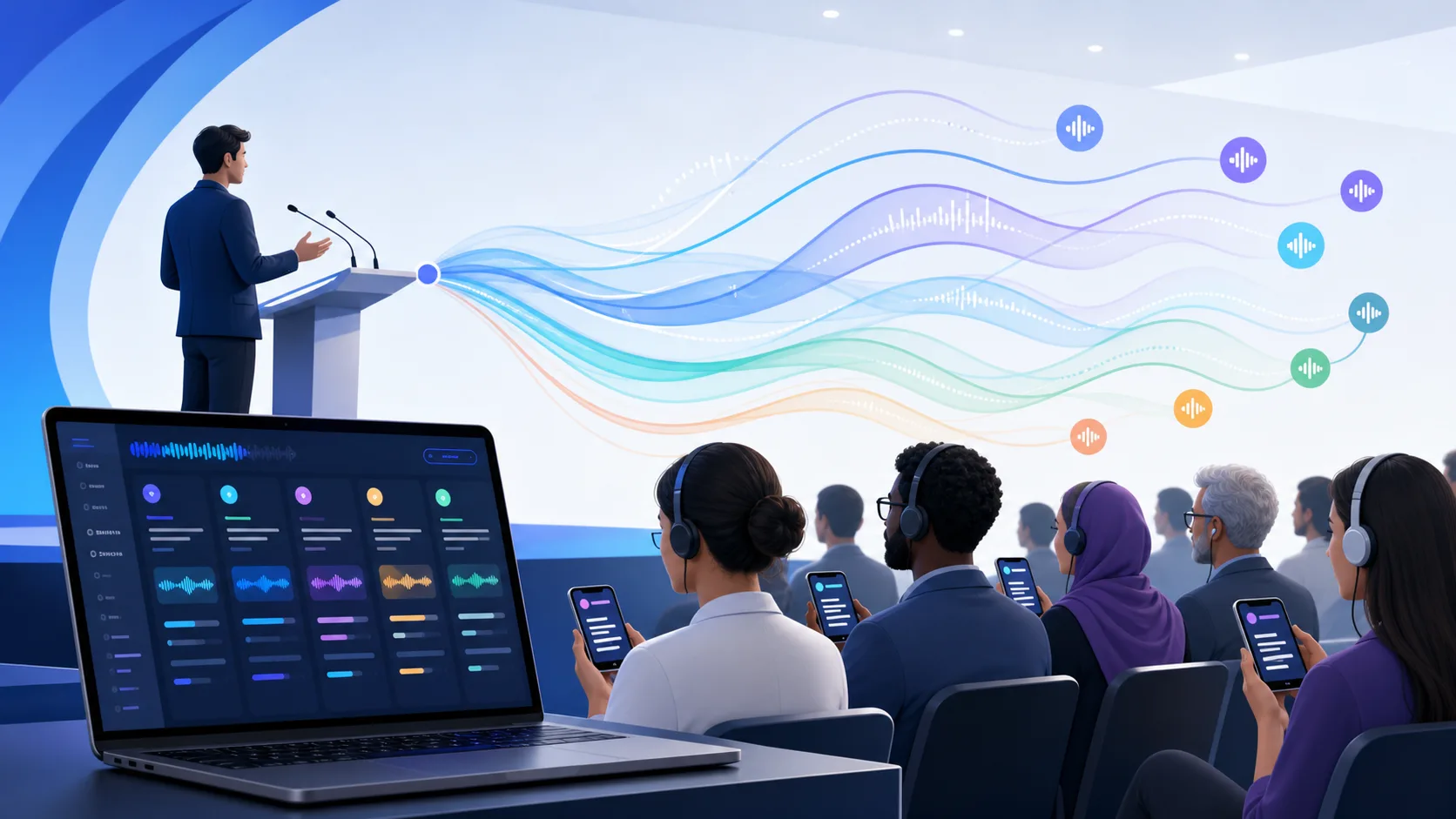
Pikka Speech turns a suitable live event audio feed into realtime captions, transcript text, and configured language outputs delivered through audience browser access. It fits conference, training, workshop, town-hall, and presentation workflows where fast access and a draft record are valuable. It does not appoint a court reporter or certify an official transcript.
Explore Pikka Speech for AI stenographyRelated stenography guides
- What is stenography?
- Stenography vs transcription
- AI captions vs human CART captioning
- Plan a staffed stenographer service in Malaysia or Singapore
Frequently asked questions
What is the difference between AI stenography and a human stenographer?
AI stenography automatically converts audio into provisional text. A human stenographer applies trained realtime writing, contextual judgement, professional responsibility, and any qualifications required by the assignment.
Can AI replace a human stenographer?
AI can replace manual capture in suitable lower-risk workflows, but it is not an automatic substitute where an official record, certification, read-back, professional accountability, or a specific accommodation is required.
Is an AI stenographer accurate enough for live events?
It can be useful for tested conferences, meetings, and presentations, but performance varies with microphones, room noise, overlapping speech, accents, languages, names, and specialist vocabulary. Test representative audio and plan human review for consequential text.
When is a human stenographer the better choice?
Choose a qualified human when the proceeding is legal, certified, evidentiary, regulated, accommodation-specific, confidential, or otherwise high consequence, subject to the rules that govern the assignment.
What is a hybrid stenography workflow?
A hybrid workflow uses AI for immediate captions and draft text while a person monitors the session, protects priority terminology, resolves uncertainty, or reviews the transcript before consequential use.