
What Is Stenography? Human vs AI Stenographers
On this pageSection guide
What is stenography?
Stenography is a family of rapid-writing methods designed to capture speech faster than ordinary longhand typing. Traditional shorthand represents sounds or words with abbreviated marks. Machine stenography uses chords: the writer presses several keys together, and realtime software translates those strokes into text through a personalised dictionary.
The word also appears in modern searches for court reporting, realtime captioning, live transcription, CART, and AI speech-to-text. Those services share a goal—turning speech into readable language—but they do not create the same kind of record or carry the same human responsibility.
Stenography
A rapid method for capturing speech in shorthand or realtime text.
Stenographer
A person trained to capture speech rapidly and prepare a usable record.
Court reporter
A professional responsible for a verbatim legal record under the applicable rules.
Captioner or CART provider
A professional who supplies realtime text for access during live communication.
What does a stenographer do?
A stenographer listens continuously, writes speech at conversation speed, identifies who is speaking, marks interruptions or non-verbal events when required, and checks the resulting text. In a legal setting, the work can support a verbatim transcript. In captioning, the work gives an audience immediate access to spoken information.
The U.S. Bureau of Labor Statistics groups court reporters and simultaneous captioners together. It reports 17,700 jobs in 2024, a median annual wage of US$67,310, and about 1,700 projected openings per year over 2024–2034. Those are U.S. labour figures, not a global market estimate, but they show that stenography spans courts, legislatures, freelance legal work, business services, meetings, and public events. See the BLS occupational profile.
The National Court Reporters Association describes court reporters as trained professionals who turn spoken words into information that can be read, searched, and archived. Its career overview also distinguishes legal reporting from broadcast and realtime access work. Read the NCRA court-reporting overview.
Where stenographers work
| Setting | Primary need | Typical output |
|---|---|---|
| Courts and depositions | Controlled verbatim legal record | Realtime feed, certified or approved transcript |
| Arbitrations and inquiries | Searchable record with clear speakers | Draft, daily copy, or final transcript |
| Broadcast and livestreams | Synchronized audience access | Open or closed captions |
| Classes and workplaces | Communication access | CART or realtime text stream |
| Conferences and meetings | Live text, languages, and post-event reference | Captions, draft transcript, summaries |
Stenography, CART, and live captions are related—not identical
CART stands for Communication Access Realtime Translation. NCRA describes CART as the instant translation of spoken words into English text using a stenotype machine, computer, and realtime software. A CART professional also decides how speaker changes and meaningful sounds should appear for the person using the captions. See NCRA's captioning explanation.
W3C's guidance for live synchronized media calls for captions that provide synchronized text for speech and relevant non-speech audio. That accessibility outcome is broader than merely printing recognised words. Read Understanding WCAG 2.2 live captions.
Stenography is not steganography
Stenography is rapid writing or speech capture. Steganography hides information inside another file or message. The words differ by one letter but describe unrelated fields. If the need involves courts, captions, transcripts, meetings, or shorthand, the intended search term is stenography.
If your requirement is already commercial, skip to the stenographer-service checklist. For an event-scale AI workflow, review Pikka Speech.
What is AI stenography?
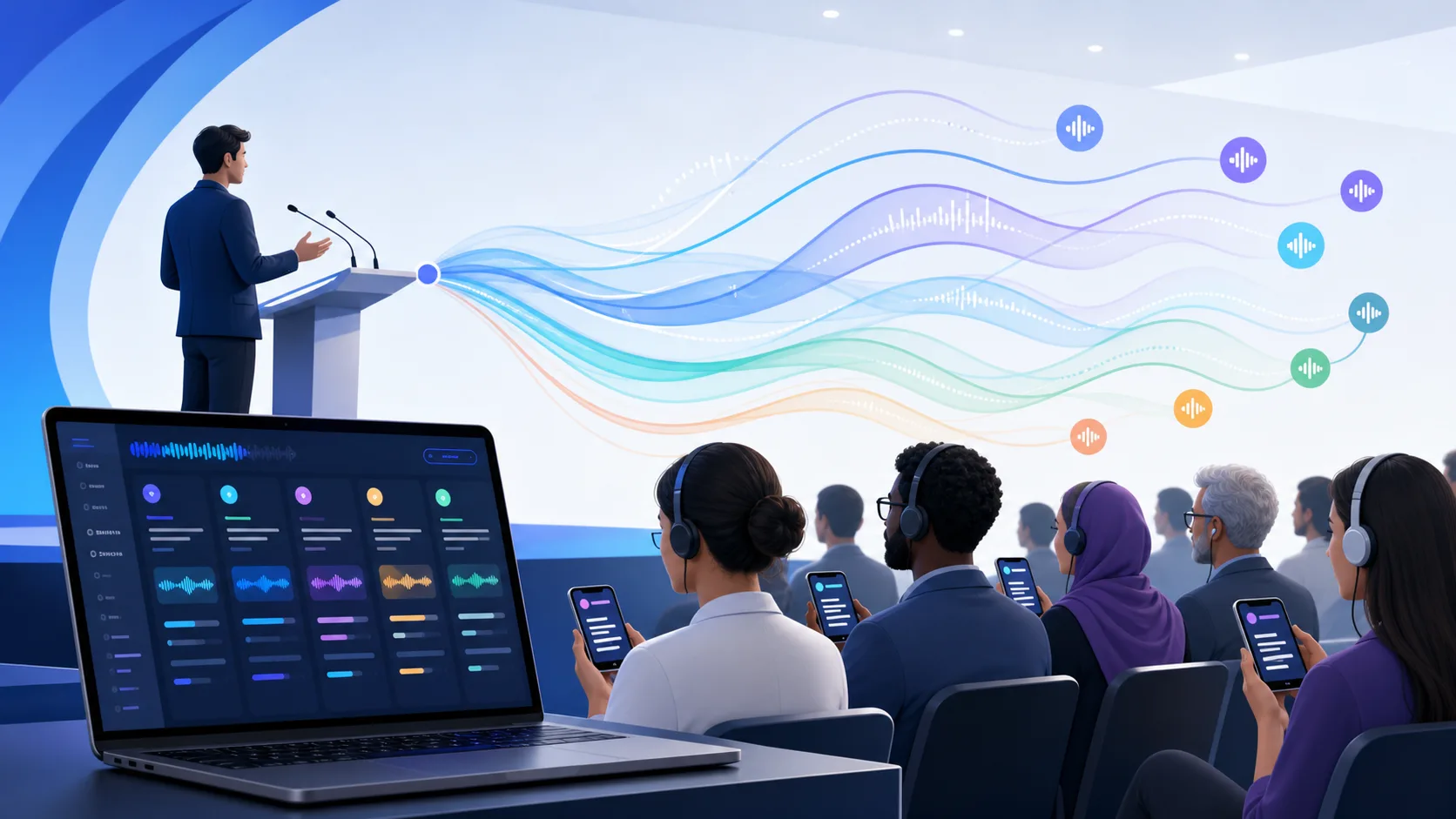
AI stenography is a practical name for a realtime speech-to-text workflow that performs part of the live capture job with automatic speech recognition. It can display provisional words, stabilize phrases, add punctuation, distinguish speaker turns, translate text, and save a draft transcript. The result is useful when speed and audience reach matter, but its status must be defined before the session begins.
The strongest workflow starts with the purpose of the text. A caption used to follow a conference session has a different error tolerance from sworn testimony, an accessibility accommodation, a medical instruction, or a certified transcript. “AI stenographer” should therefore describe the delivery method—not imply a qualification the system does not hold.
How AI stenography works
- Capture the source audio. A direct mixer feed or close microphone gives the speech service a cleaner signal than a distant device in a reverberant room.
- Recognize provisional speech. The system turns incoming audio into words while the speaker is still talking. Early wording may change as more context arrives.
- Stabilize readable text. Finalized segments add punctuation, timing, and speaker boundaries without repeatedly appending partial text.
- Deliver the text. Captions can appear on a room display, a browser page, remote participant screens, or a production output.
- Review according to risk. Names, numbers, technical terms, unclear audio, and consequential statements receive the level of human checking the use case requires.
Human stenographer vs AI stenography vs hybrid review
| Decision factor | Human stenographer | AI stenography | Hybrid workflow |
|---|---|---|---|
| Best fit | Official, certified, regulated, or high-consequence records | Scalable event captions and draft transcripts | Live speed with planned correction or review |
| Judgement | Applies professional and contextual judgement | Infers text from the audio and configured context | Human monitors priority terms and corrects the draft |
| Languages and scale | Depends on qualified professional availability | Can expand suitable event language access | Automation covers scale; people focus on risk |
| Audio dependence | Can request clarification within the permitted process | Quality falls when the input is noisy or overlapping | Operator improves feeds and flags uncertain passages |
| Record status | May create the required record when properly appointed or qualified | Creates provisional text unless the governing process says otherwise | Status depends on the reviewer and agreed workflow |
Can AI replace a stenographer?
AI can replace manual typing in some low- and medium-consequence capture workflows. It can also extend live text to more rooms or languages when the alternative is no text at all. AI is not an automatic substitute for a trained human when a proceeding requires impartiality, certification, read-back, controlled exhibits, a chain of custody, or a specific reasonable accommodation.
NCRA's current position treats AI and automatic speech recognition as supplemental tools and rejects them as replacements for trained, certified human court reporters or captioners in creating, preserving, and certifying the official record. That is a professional-association position rather than a universal law, but it is a clear planning boundary for buyers. Read the NCRA AI position statement.
Stenography vs transcription, captions, and subtitles
Stenography
A rapid capture method or professional practice used while speech happens.
Transcription
The broader creation of written text from live speech or a recording.
Captions
Time-synchronized text designed to make speech and relevant audio readable during media or an event.
Subtitles
Timed text commonly used for dialogue, translation, or recorded-video viewing.
One workflow can produce several outputs: live captions during the event, a transcript after the event, and subtitles for a recording. Read the detailed guide to AI transcription vs captions vs subtitles.
What determines AI stenography quality?
Audio quality sets the ceiling. Distance, reverberation, overlapping speech, compressed conference audio, unexpected language switching, names, acronyms, and specialist vocabulary all affect the text. A single headline accuracy percentage cannot describe those conditions honestly.
- Test the exact source language, accents, microphones, room, and network path.
- Supply names, organisations, abbreviations, and agenda terminology before the event.
- Score omissions, names, numbers, negation, speaker attribution, and timing separately.
- Check how provisional words become final text; unstable captions can be hard to read.
- Define who monitors the live feed and what happens when the audio or network fails.
How Pikka Speech fits an AI stenography workflow
Pikka Speech turns a live event feed into captions, transcript text, and configured language outputs. Organisers create a browser-based event room, connect suitable audio, and share audience access by link or QR code. Attendees can follow text on their own devices, while an operator manages the event workflow.
Pikka Speech fits conferences, town halls, workshops, training, public presentations, and multilingual events where live access and a draft record are valuable. It does not turn an event transcript into a certified court record by itself. Organisers remain responsible for selecting qualified people and processes wherever the record or accommodation demands them.
Explore Pikka Speech for live eventsWhen should you hire a stenographer service?
Hire a professional stenographer or court-reporting service when the consequence of an error is high or when a rule, contract, institution, or accommodation plan specifies the method or qualification. Common signals include legal proceedings, depositions, arbitrations, formal inquiries, certified transcripts, read-back, confidential evidence, and individual CART requirements.
Use an AI stenography workflow when the primary need is scalable live text, searchable event notes, multilingual audience access, or a draft transcript that will be reviewed before consequential use. Choose hybrid delivery when the session needs live scale but particular names, numbers, decisions, or published passages must receive human attention.
Stenography service use-case map
| Search intent | Likely requirement | Start with |
|---|---|---|
| Court stenographer or court reporter | Official or legally controlled record | Applicable court rules and a qualified professional |
| Deposition or arbitration stenographer | Verbatim record, realtime feed, transcript delivery | Qualified legal reporting service |
| CART captioning service | Communication access for a named audience or participant | Qualified CART or access professional |
| Conference stenographer | Live captions plus event transcript | Human, AI, or hybrid after risk assessment |
| AI stenographer service | Scalable live text, draft transcript, optional language access | Tested event workflow with explicit review status |
| Remote stenography service | Off-site capture from a clean audio feed | Provider with tested connectivity, security, and backup |
How to choose a stenographer service
- Define the record. State whether you need live access, a rough draft, an edited transcript, a certified record, subtitles, or several outputs.
- Check the governing requirement. Ask the court, institution, accessibility lead, legal adviser, or contracting authority which qualifications and methods are accepted.
- Describe the session. Share date, duration, location, remote platform, languages, speaker count, breakouts, confidentiality, and expected audience size.
- Plan the audio. Confirm microphones, mixer access, remote feeds, recording permission, monitoring, and a fallback path.
- Test terminology. Provide names, acronyms, case references, product terms, agenda documents, and any words that must appear exactly.
- Agree on correction and delivery. Define live corrections, review scope, turnaround, timestamps, speaker labels, formats, retention, and deletion.
Questions to ask before booking
Malaysia and Singapore stenographer services
Buyers searching for a staffed stenographer service in Malaysia or Singapore usually need a project plan, not just software. The provider should confirm venue audio, on-site or remote delivery, human oversight, languages, transcript status, turnaround, and the applicable legal or institutional requirements.
Translife offers project-managed AI stenography and transcription support for suitable legal, corporate, academic, and event settings across Malaysia and Singapore. Review the scope and request a session-specific quote on the Translife stenographer service page. A service provider cannot decide whether a particular output satisfies your court, regulator, contract, or accommodation obligation; confirm that requirement with the relevant authority.
Which stenography path should you choose?
- Choose a qualified human professional for official, certified, regulated, or accommodation-specific records.
- Choose AI stenography for tested live event captions, audience access, searchable drafts, and scalable language workflows.
- Choose hybrid review when automation supplies reach but people must protect names, numbers, decisions, and final publication quality.
For deeper evaluation, compare stenography with transcription, choose between AI stenography and a human stenographer, or review AI captions with human CART captioning.
Frequently asked questions about stenography
What is stenography?
Stenography is the rapid capture of spoken language in shorthand or realtime text. A trained stenographer may use a chorded stenotype machine, voice writing, or another approved method to create a readable record while people speak.
What does a stenographer do?
A stenographer captures speech accurately, identifies speakers, marks the record, resolves unclear passages, and prepares or supports a transcript. The exact duty depends on whether the setting is a court, deposition, meeting, broadcast, classroom, conference, or accessibility service.
How does a stenotype machine work?
A stenotype machine lets a writer press several keys together to represent sounds, syllables, phrases, or whole words. Realtime software translates those chords through the writer's dictionary into readable text.
Is stenography the same as transcription?
No. Stenography describes a rapid capture method, often used while speech is happening. Transcription is the broader process of producing written text from speech and may be completed live or from a recording.
What is CART captioning?
Communication Access Realtime Translation, or CART, delivers spoken language and relevant audio information as readable text while an event, class, meeting, or programme is happening. A qualified CART professional applies captioning judgement as well as realtime writing skill.
Can AI replace a stenographer?
AI can provide fast live captions and draft transcripts for suitable meetings and events, but it is not an automatic substitute for a trained human when an official, certified, legally controlled, or accommodation-specific record is required.
When should I hire a stenographer service?
Hire a professional service when the record has legal, regulatory, accessibility, evidentiary, certification, confidentiality, or high-consequence requirements. Confirm the required qualification, method, turnaround, security, read-back, correction, and transcript format before booking.
How does Pikka Speech support AI stenography?
Pikka Speech converts a clean live event audio feed into realtime captions, transcript text, and configured language outputs for browser-based audiences. It fits event access and draft-record workflows; the organiser must separately establish any human-review, certification, or official-record requirement.
Key takeaway
Stenography is the rapid capture of speech; a stenographer is the trained person who performs and manages that work. AI stenography can expand live text, draft transcripts, and language access, while human professionals remain essential wherever qualification, judgement, certification, or an official record is required.
Source review completed August 9, 2026. Requirements vary by country, court, institution, contract, and accessibility plan; verify the rules that govern your session.