
Reuse installed distribution
Transmitters, radiators or antennas, receivers, headphones, charging routines, and the receiver desk can stay in the event plan when they are compatible and serviceable.
Keep the transmitter. Keep the receivers. Use Pikka Speech to produce selected AI language channels without rebuilding the audience distribution system that already works.
Catalog compatibility, venue hardware, language suitability, and the complete signal path must be checked before purchase or show day.
The retained-receiver route
The short answer
A compatible installed interpretation system can keep carrying audio to attendee receivers while Pikka Speech creates one or more selected AI language channels. The venue routes a clean mixer feed into the Pikka production workflow, takes the chosen language through a suitable professional output, and patches it into an available transmitter input or channel.
Transmitters, radiators or antennas, receivers, headphones, charging routines, and the receiver desk can stay in the event plan when they are compatible and serviceable.
Receiver listeners use the venue's installed distribution route rather than opening a browser audio stream on every phone.
No interpreter booth or interpreter console is required for a selected AI language channel. The production and monitoring responsibilities remain.
The same event can plan receiver audio, browser audio, translated text, caption displays, and human-interpreted channels according to the real requirement.
This is the simplest correct description of the retained-receiver route. The connector types, levels, and channel map must match the venue's actual transmitter and input architecture.
Pikka can replace the booth–console–human-interpreter production path for selected AI channels. It does not automatically replace the venue mixer, audio interface, transmitter, radiators or antennas, receivers, headphones, cabling, network, operators, or professional human safeguards. That narrower definition is more useful because it tells an AV team exactly what changes and what remains under its control.
It also makes the pilot reversible. A temporary Pikka output can enter a spare compatible transmitter input without dismantling the installed system. If rehearsal fails the event's acceptance criteria, the venue can remove the patch and use its approved fallback. The existing audience distribution estate does not have to be discarded to evaluate a different language-production layer.
System architecture
Live mixer feed → Pikka Speech → professional audio output → transmitter → receivers. This is the whole proposed route at a functional level. The implementation details depend on the venue's console, computer, operating system, audio interface, transmitter, cabling, grounding, and channel map.
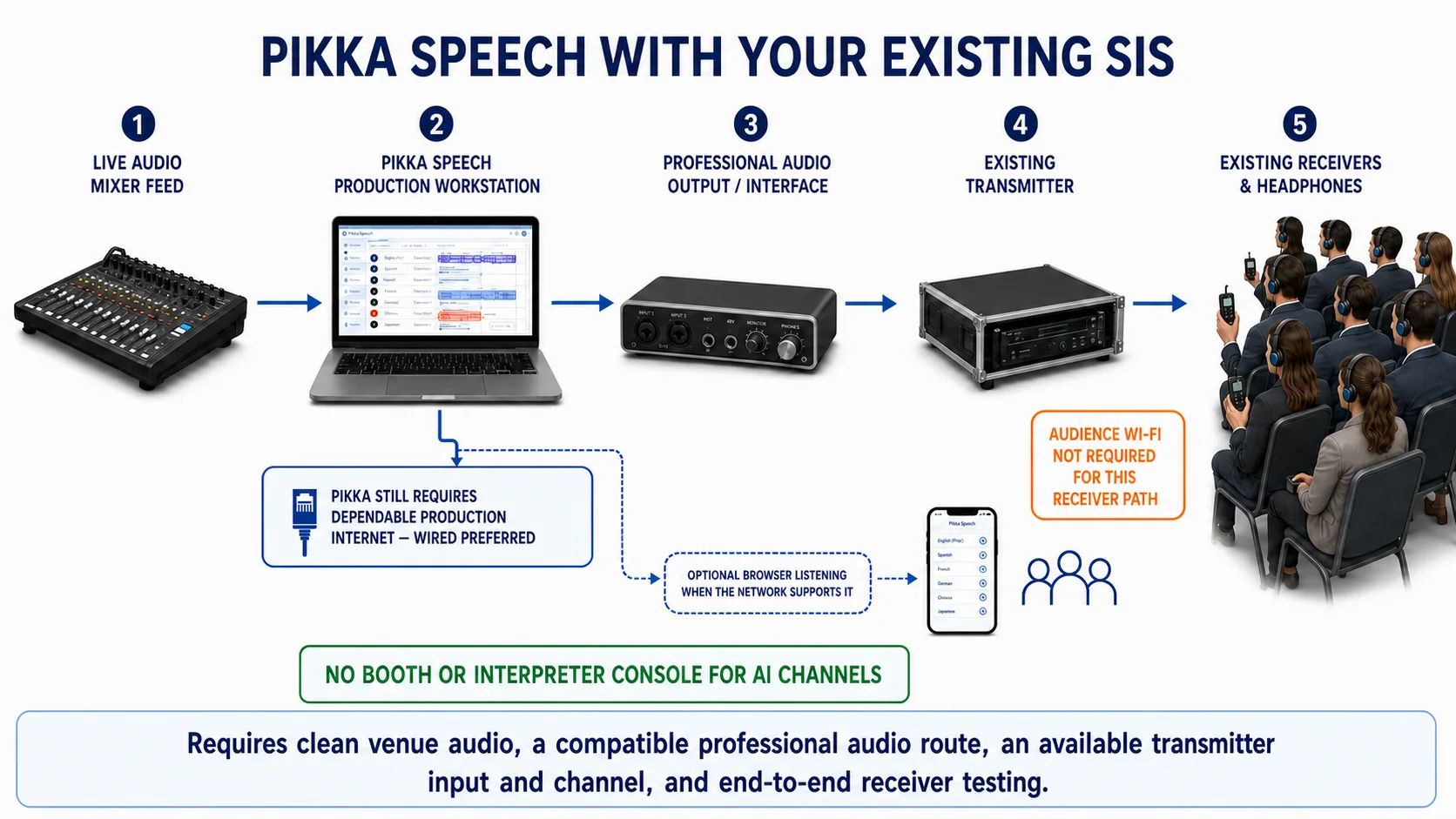
“Compatible” is a real engineering condition. Some systems accept analogue line inputs; others depend on a conference-system network, a proprietary interface, Dante or another digital-audio design. Input counts, nominal levels, balanced or unbalanced connections, routing permissions, sample rates, clocking, licensing, and channel configuration vary. Pikka should never be described as a drop-in native integration for every transmitter. The approved design is the one that the equipment documentation and an end-to-end test support.
Each simultaneous target needs an output route the production team can control and monitor. A five-language catalog selection does not prove that the computer, audio interface, or transmitter has five usable independent paths. Count the physical and logical outputs, count the available transmitter inputs and licensed channels, then map one language name consistently from Pikka to interface to rack to receiver display.
Why Pikka
Pikka's best case is a venue that already trusts its receiver coverage but wants a more flexible way to create selected language channels. The value comes from changing the production topology, concentrating network demand, and keeping delivery choices open.
A maintained transmitter, radiator or antenna network, receivers, charging inventory, and trained distribution staff remain useful. The project focuses on a new input path instead of pretending the entire system has no value.
Those channels do not require booth space, an interpreter console, or a human interpreter audio position. This can matter where floor area, lead time, or language availability is constrained.
Hundreds of receiver listeners do not each create a browser audio session. The critical online path is the Pikka production workstation, which can be placed on a controlled wired network and actively monitored.
Use installed receivers for the main room, browser listening for remote or overflow attendees, translated text for people who prefer reading, and caption displays for shared visibility. Delivery does not have to be one-size-fits-all.
Use tested AI output where the content and consequence allow it, while preserving qualified human interpretation for sessions where nuance, duty of care, or regulation demands it.
The reviewed configuration lists $499 for AI interpretation plus a $49 target-language base. Buyers can begin with a checkable Pikka subtotal, then add the real hardware, labour, connectivity, and fallback costs.
Network design
Event Wi-Fi can be adequate for email and still be a poor foundation for hundreds of concurrent, delay-sensitive audio listeners. Capacity, access-point placement, radio interference, authentication portals, device power saving, and the audience's own handset behaviour all affect the result. Existing infrared or RF receivers move that last-mile audio delivery onto a purpose-built venue route.
“Attendees listening on the venue receivers do not require venue Wi-Fi; the Pikka production workstation requires a dependable internet connection.”
This wording separates audience distribution from AI production. It prevents the unsafe inference that the complete solution works offline.
The production connection deserves more attention precisely because it becomes concentrated. Put the Pikka computer on a network intended for production, not a public attendee SSID. Prefer wired Ethernet where the venue supports it. Measure the real route during the rehearsal window, including any firewall, captive portal, proxy, VLAN, DNS, or security control that will exist on show day.
A backup should be materially useful, not just another name for the same upstream failure. The correct design varies by venue and risk: a second wired service, managed cellular path, another provider, or a return to an approved human or single-language plan may be appropriate. Test the switchover and document who can invoke it. Do not promise seamless continuity unless the exact failover has been proven.
Receivers introduce their own operational dependencies. Infrared coverage can be affected by room geometry, obstructions, and lighting; RF systems have frequency and regulatory considerations; every system depends on charged batteries, functioning headphones, correct channel maps, and controlled distribution. Pikka reduces one network burden. It does not abolish receiver-system engineering.
Compatibility
Start with the exact manufacturer, model, firmware, channel license, input module, and current rack drawing. A generic product category is not enough. The following checklist turns “we have an SIS” into a verifiable production design.
The Bosch INTEGRUS documentation linked in the source section is a useful concrete example: it describes a system composed of a transmitter, infrared radiators, multi-channel pocket receivers, charging equipment, and associated configuration. It does not prove that Pikka connects directly to every INTEGRUS installation. It demonstrates why “the SIS” is a chain of distinct components and why the exact input architecture matters.
ISO 20109:2025 addresses requirements for simultaneous-interpreting equipment and sound and image quality. ISO 24019:2022 addresses simultaneous-interpreting delivery platforms where interpreters are remote from the venue. These standards inform procurement questions; this page does not claim that Pikka Speech, a venue, or a proposed hybrid is certified merely because the standards are cited. Buyers should identify which standards, contracts, accessibility duties, frequency rules, and professional requirements actually apply to their event and jurisdiction.
Audience delivery
Existing receivers are not automatically better than browser listening, and browser listening is not automatically simpler. The right route follows the room, network, audience, equipment, remote-participation requirement, and operating team.
Pikka's advantage is the ability to participate in more than one of these designs. The product can serve browser listeners, while a production output can feed a compatible transmitter for receiver listeners. Text and caption displays can supplement audio. The producer still has to prevent echo, avoid attendees monitoring two delayed routes at once, label each channel, and test remote and in-room paths separately.
Language risk
A transmitter can distribute a technically clean channel whose meaning is wrong. Audio distribution quality and interpreting quality are different. AI output can mistranslate names, numbers, units, negation, specialist terms, idioms, accents, code-switching, overlapping speech, jokes, or context that a qualified professional would manage differently.
Use the speakers, microphones, room acoustics, terminology, pace, language pair, and routing expected at the event. A clean demo sentence is not an acceptance test for a panel, Q&A, or technical keynote.
Ask what happens if a name, number, instruction, qualification, or negative is wrong. Health, law, safety, consent, rights, crisis, discipline, finance, and diplomacy deserve stronger safeguards.
Decide who monitors each channel, how an attendee reports a problem, when a producer mutes or relabels a channel, and what approved alternative remains available.
General informational sessions with clear speech, prepared vocabulary, and a practical correction path may be candidates for a rehearsed AI channel. Medical, legal, safety-critical, rights-affecting, crisis, disciplinary, diplomatic, or similarly consequential communication may require qualified human interpreters and domain-specific controls. Sign-language access is a distinct requirement and must not be represented as covered by an AI audio channel.
Hybrid planning can expand access without forcing an all-AI decision. Keep professional interpreters on the languages or sessions with the highest consequence, and evaluate Pikka for additional informational channels that pass the event's tests. If both types enter the same transmitter, label them by language and disclose automated interpreting where appropriate or required. Do not invent an accuracy percentage: no single number can describe every language, speaker, room, topic, and comparison method.
The National Council on Interpreting in Health Care publishes guidance for contracting AI-generated interpreting. It is healthcare-specific, not a general event standard, but its emphasis on performance, limitations, privacy, disclosure, monitoring, and escalation illustrates the questions high-consequence buyers should ask. Apply the professional and legal framework relevant to the actual event.
Commercial model
The reviewed Pikka configuration prices an AI audio language as a target-language base plus AI interpretation. It also separates listener additions, text translation, caption displays, and video. These values are a planning starting point, not a quote for the entire installed-receiver solution.
$548
$49 target base + $499 AI interpretation; 25 listeners included.
$2
Per listener beyond the included count in the reviewed configuration.
$398
The first 25 listeners are included; additional text listeners are $1 each.
$250
A separate event component; confirm the screen, operator, and physical AV delivery independently.
Do not compare a Pikka software subtotal with a traditional supplier's complete event quotation and call the difference “savings.” Put identical language counts, hours, listeners, equipment, labour, rehearsal, support, fallback, taxes, and risk obligations on both sides. The structural advantage is clear: a selected AI channel does not use the booth-console-interpreter production chain. The financial result is event-specific.
Existing equipment is not free simply because the venue owns it. Include receiver preparation, batteries or charging, cleaning, issue and return, lost-unit exposure, technicians, rack access, maintenance, and coverage work. Conversely, do not charge the traditional proposal for hardware the Pikka hybrid still uses. A defensible comparison keeps retained costs on both sides and removes only the resources the chosen architecture actually removes.
Deployment
A safe first deployment is reversible and evidence-led. Keep the installed configuration intact, use an available compatible input, and define acceptance criteria before the rehearsal begins.
Owns the approved scope, schedule, audience promise, supplier coordination, decision log, and authority to change or stop the plan. The producer makes sure every language and delivery route has an owner instead of assuming the AV team controls language quality.
Owns the source mix, rack access, professional output path, transmitter configuration, distribution coverage, power, cabling, and restoration of the known venue state. This role approves the physical and digital audio interfaces used in the room.
Owns the event-room configuration, source and target selection, application and network monitoring, output assignment, language-channel checks, incident log, and escalation into the fallback. The operator listens to the delivered output rather than monitoring only the interface.
Owns representative content, terminology, AI-versus-human decisions, acceptance criteria, disclosure, sensitive-session safeguards, and the response to a language-quality problem. This may be a professional language lead, compliance owner, or another qualified event stakeholder.
Record manufacturer, model, firmware, transmission technology, channel licenses, input modules, rack patch, coverage, receiver count, charging, headphones, configuration owner, and recent service history. Photograph labels and preserve the currently working configuration before changing it.
List every source, target, session, listener count, delivery route, and consequence class. Mark each language as Pikka AI, professional human, browser text, caption display, undecided, or unavailable. Do not design outputs for targets the current source configuration does not offer.
Use the 15-minute test with representative voices and content. Confirm source-to-target availability rather than relying on catalog totals. Include names, technical terms, numbers, accents, speaker pace, and remote contributors expected at the real event.
Assign one controlled output route for every simultaneous language sent to the transmitter. Label the software channel, audio-interface output, patch cable, transmitter input, receiver channel, and monitoring point with one consistent name. Confirm level, isolation, grounding, clocking, and channel separation.
Start at every speaker microphone and finish at real receivers in occupied-room positions. Test normal speech, fast speech, Q&A, overlapping speech, silence, cable movement, device reconnection, channel changes, remote speakers, and coverage. Record what passed and what needs a different plan.
Interrupt the primary network in a controlled rehearsal, disconnect an output, select the wrong channel, introduce a low battery, and verify the documented response. Check that the operator can identify whether a problem belongs to source audio, Pikka, the output route, transmitter distribution, or one receiver.
Publish a simple language-channel map. Train receiver-desk and floor staff. Explain whether a browser alternative exists, where headphones are collected, how problems are reported, what automated-interpreting disclosure applies, and what listeners should do if a channel is interrupted.
A named operator should hear the source and each critical output, watch network and application state, coordinate with the mixer and receiver desk, log incidents, and have authority to invoke fallback. A green application screen is not proof that the audience receiver sounds correct.
Compare rehearsal and show evidence with the acceptance criteria. Record language-quality issues separately from network, routing, distribution, and audience-support issues. Expand only the parts that passed, and retain the exact equipment and configuration record for the next venue or room.
Record the date, room, production computer, network route, source and targets, speaker sample, mixer output, interface outputs, transmitter inputs, receiver models, tested positions, operators, observed issues, decisions, and fallback result. “Sounded fine in the office” is not evidence for an event rack. A short written record makes future rooms faster and prevents an untested change from being mistaken for the approved design.
Fit assessment
The retained-receiver route is especially compelling when a reliable installed distribution system meets weak or uncertain audience Wi-Fi. It is not automatically the best design for a venue with no usable transmitter, a fully remote audience, or content that should not be assigned to AI.
A venue without receivers may prefer Pikka's browser-listener workflow. A venue with strong audience connectivity may choose browsers even when receivers exist, especially for remote access or simpler hardware logistics. An event with a small number of sensitive language channels may choose professional human interpreting throughout. The solution page identifies the high-value installed-system case; it does not make every event look identical.
The final decision should be written at channel level, not product level. One event might approve Pikka audio in three informational languages, keep a professional interpreter on a legal or safety channel, provide browser text in two more languages, and use a shared caption screen. That plan is more precise than calling the whole event “AI” or “traditional,” and it makes ownership and fallback clearer.
Procurement
A strong proposal names the source, transformation, output, transmitter input, distribution channel, receiver setting, operator, test, and fallback. These questions expose gaps before they become show-day surprises.
Which exact source-to-target configurations are available in the current Pikka room?
What representative event audio will be used to accept or reject each AI channel?
Which mixer output feeds Pikka, and does it include every in-room and remote speaker?
Which professional audio device creates each independent language output?
Which exact transmitter input, level, connector, license, and channel receives each output?
Who has authority to change the transmitter and rack configuration?
Which receiver model and channel number will attendees use for every language?
Where has coverage been walked with real receivers, and what dead zones remain?
Which network serves the Pikka production computer, and how independent is the backup?
Who monitors language output, application state, audio routing, and audience reports?
Which sessions or languages stay with qualified human interpreters, and why?
What is the complete event bill, including Pikka, hardware, labour, network, receivers, rehearsal, support, and fallback?
Ask the Pikka owner, venue AV team, interpretation-system supplier, network team, event producer, language lead, and safety or compliance owner to answer the questions that belong to them. No single supplier controls the entire hybrid. The handoffs are where assumptions accumulate, so the proposal should show who approves each one.
Answers
These answers state the intended scope and the conditions that must be verified. They are not a substitute for the current Pikka configuration, equipment documentation, or an event-specific technical design.
It can be routed into an existing system when the venue has a compatible, available transmitter input or language channel and the production team can provide a suitable professional audio output. This is an engineered audio connection, not a claim of native integration with every transmitter model. Confirm connector type, signal level, routing, channel capacity, and end-to-end receiver performance before the event.
No. Attendees on the retained receiver path receive the selected language through the installed infrared, radio-frequency, or other venue distribution system, so their receivers do not need the venue Wi-Fi. The production computer running Pikka Speech still needs dependable internet, and a wired production connection is preferred where available.
No. Moving audience delivery to receivers reduces the number of attendee devices depending on venue Wi-Fi; it does not make AI language production offline. Pikka Speech still requires an internet-connected production workstation. Plan and test a primary connection, an appropriate backup, and a fallback for the event's risk level.
No interpreter booth or interpreter console is required for a selected AI language channel. The event still needs a clean source feed, a suitable computer and output route, a compatible transmitter input, monitoring, and a technician or operator responsible for the system. Human-interpreted channels may still use booths or another approved working environment.
Not in this architecture. Pikka Speech changes the language-production stage while the transmitter, radiators or antennas, receivers, headphones, and receiver-desk workflow remain in service. Pikka also supports browser listening, but the retained-receiver option is specifically designed to preserve compatible installed distribution equipment.
The practical count depends on the selected Pikka language compatibility, available computer outputs, audio-interface routing, transmitter inputs, licensed or configured channels, and the venue's distribution design. Do not infer a channel count from the language catalog. Map and test every concurrent output as a separate production path.
As reviewed on August 3, 2026, the production catalog contains 99 source-language codes and 142 listener language or dialect codes. Compatibility rules determine which listener targets are available for a selected source, so these catalog totals do not mean that every possible pair is available or performs identically.
Yes, if the complete system has enough compatible inputs, outputs, and distribution channels. A producer can retain professional human interpretation for high-consequence or complex sessions and use tested AI channels for suitable informational content. Each channel needs an unambiguous label, monitoring plan, attendee instruction, and fallback.
There is no universal connector or level. The production team must check the exact transmitter documentation and rack design, then choose a professional audio interface, cable, transformer, digital-audio route, or other approved bridge that matches it. Do not connect consumer headphone output to an unknown rack input and assume the levels, grounding, or channel mapping are correct.
No. Automated interpreting can make errors involving names, numbers, terminology, negation, accents, overlapping speech, or context. Use representative rehearsal audio and assess the consequence of error. Medical, legal, safety-critical, rights-affecting, crisis, diplomatic, or similarly sensitive communication may require qualified human interpreters and domain-specific safeguards.
Evidence and review
Product and pricing statements were reviewed against the current Pikka configuration on August 3, 2026. Equipment and professional-context statements use the primary sources listed here. Links do not imply certification, compatibility, endorsement, or universal suitability.
Search engines cannot guarantee a number-one ranking. This page is structured to answer the commercial query accurately, expose its evidence, and connect to the deeper engineering guide; rankings still depend on indexing, authority, competition, and user response.
Start with Pikka Speech's 15-minute test. Then bring the result to the venue's AV owner to verify the professional output, compatible transmitter input, receiver channel, coverage, production connection, and fallback.