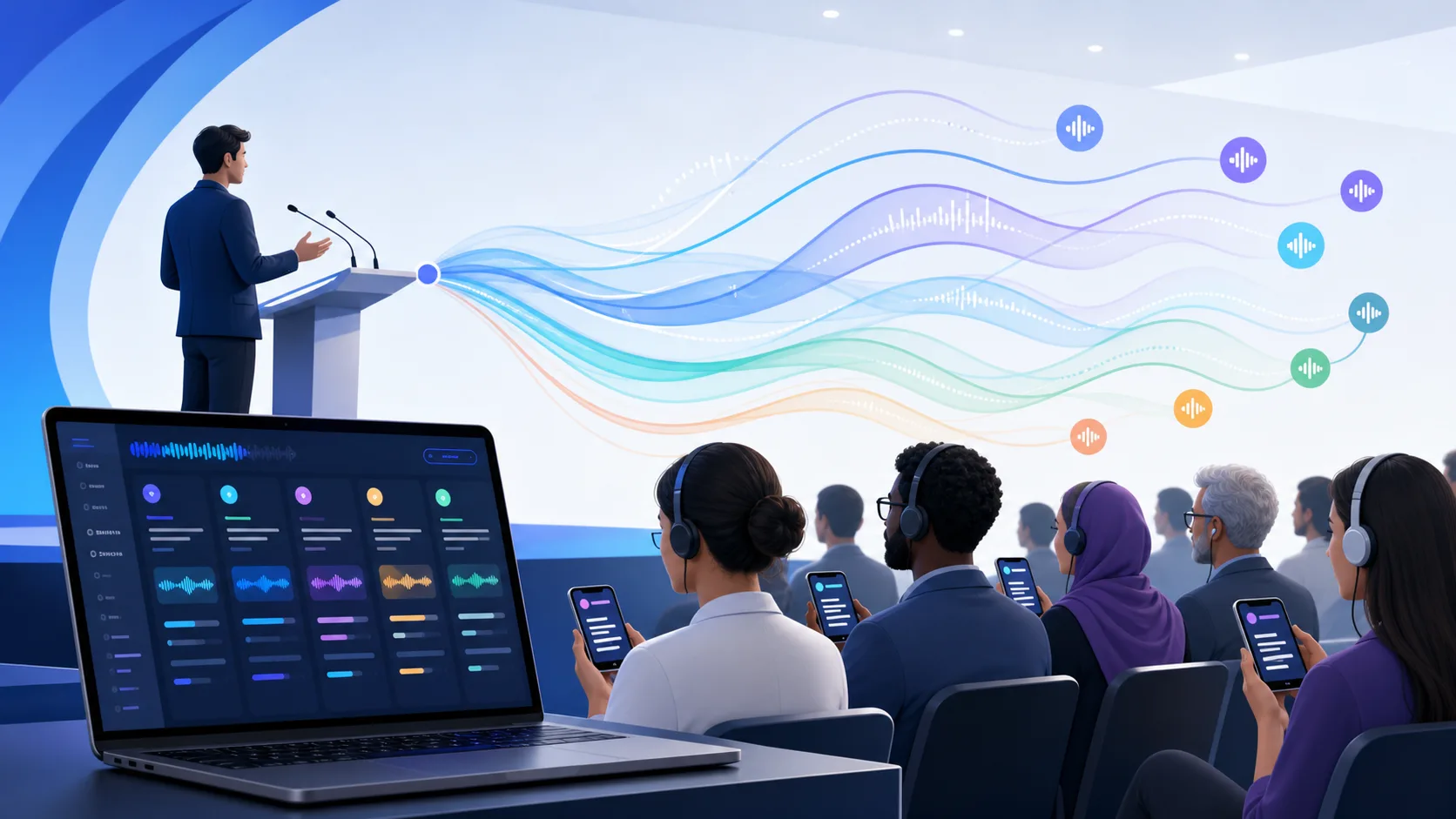
Pikka Speech vs AI-Media LEXI: multilingual event room or specialized captioning stack?
Pikka Speech and AI-Media overlap in live captions and language access, but their centers of gravity differ. Pikka packages a software-first multilingual event room. AI-Media offers a wider captioning and production family spanning LEXI Text, translation and voice products, browser display, SDI hardware, and on-premises options.
Written by Pikka AI Team · Reviewed August 23, 2026 · 34-minute in-depth comparison
The short verdict
Pikka Speech is the clearer choice for event organizers who need translated attendee audio and text in one browser-first room, want public per-event pricing, or need AI and human language channels together. AI-Media LEXI is the stronger documented choice for broadcast-grade caption workflows, HD-SDI display appliances, multiple production display modes, on-premises captioning, or organizations already operating the EEG and iCap ecosystem.
This comparison evaluates fit, not a universal winner. AI-Media also has browser and voice-translation products, so it is inaccurate to label the whole family hardware-only or captions-only. No accuracy winner is declared because the published AI-Media percentages are vendor-reported and no controlled Pikka-versus-LEXI benchmark was found.
Where Pikka Speech has the clearest advantage
One event room for translated attendee audio and text
Pikka is organized around a multilingual event room: configure target channels, give attendees browser access, and deliver translated audio or text from the same operating context.
AI-Media has captioning, translation, voice translation, web display, and hardware products, but buyers must identify which LEXI and display components form the required workflow.
Published event pricing
Pikka publishes per-language, caption-display, and listener amounts, allowing common event totals to be calculated before a sales call.
AI-Media documents monthly, block-hour, power-user, per-session, and hardware-plus-service models, but the reviewed pages do not display the relevant dollar amounts. Public transparency does not prove the lowest final price.
Software-first listener delivery
Pikka's core audience path uses event links or QR access on attendee devices, without requiring an HD-SDI caption appliance for the standard room workflow.
AI-Media also offers browser delivery through AI-Live; hardware is not universally required. The Pikka advantage is a unified event-language workflow, not a claim that every AI-Media deployment requires hardware.
Explicit language catalog breadth
Pikka's production catalog contains 99 source-language codes and 142 listener language or dialect codes on the review date, combining into 13,635 directed language pairs after compatibility exclusions.
AI-Media publishes separate language information for LEXI Text recognition and LEXI Translate pair support. Buyers must compare the exact caption and translation path rather than a single headline count.
AI, human, and hybrid channels in one room
Pikka can set each target channel to AI, human-only, or hybrid coverage, which is useful when risk and interpreter availability vary by language.
AI-Media can source LEXI Viewer captions from automatic LEXI or human captioners over iCap, which is a different production model. This comparison does not claim AI-Media lacks human services.
Granular text-only economics
Pikka publishes a $398 text-only target-language event tier and a lower $1 paid-listener unit for text-only delivery.
AI-Media's captioning focus may be a better technical fit for specialized caption production, but its reviewed pages do not expose an equivalent public per-event multilingual text formula.
At-a-glance comparison
AI-Media LEXI is a family, not one product. The table names the relevant component whenever possible. Pikka facts come from the production event configuration; AI-Media facts come from its current LEXI Text, LEXI Viewer, and LEXI Translate materials.
Decision factor
Pikka Speech
AI-Media LEXI
Buyer interpretation
Primary product shape
A multilingual event room for translated audio, text, listener access, caption displays, transcripts, and mixed channel coverage.
A product family spanning LEXI Text captioning, LEXI Translate, LEXI Voice, AI-Live web display, LEXI Viewer hardware, LEXI Local, and related delivery infrastructure.
Pikka is easier to scope as one event-language workflow. AI-Media offers deeper specialized caption-production paths.
Public pricing model
$548 AI audio or $398 text only per target language for an event up to 14 hours, plus published display and listener units.
Monthly usage, 12-month block hours, 24/7 power-user options, per-session AI-Live, and hardware-plus-service models; reviewed pages do not show dollar amounts.
Pikka has the public budget-transparency advantage. Obtain an AI-Media quote for a total-cost comparison.
Attendee delivery
Browser listener link or QR path with event-selected language outputs.
AI-Live streams captions to web-enabled devices; other paths target broadcast or room displays.
Both can serve browsers. Pikka centers multilingual attendee audio and text; AI-Media offers multiple caption-display architectures.
Fixed AV hardware
Not required for the core browser event-room path; venue audio and network infrastructure are still required.
Optional depending on workflow. LEXI Viewer AV610 is an HD-SDI appliance; AI-Live is browser based; an encoder can be added to LEXI Text if required.
Pikka has a simpler default hardware footprint. AI-Media has the stronger documented appliance path for professional video production.
Display control
Optional live caption display with browser-based screen configuration for event viewing.
LEXI Viewer offers full-screen, background image, decoder, and scaler modes with SDI-oriented display control.
AI-Media is stronger when video insertion and production display modes are mandatory.
Language statement
99 source codes and 142 listener language or dialect codes in the production catalog, combining into 13,635 directed pairs.
LEXI Text publishes a named recognition-language list; LEXI Translate publishes a separate source-target support matrix.
Pikka gives a broad unified catalog count. Test AI-Media's exact component chain and both products' required pairs.
Accuracy evidence
No comparative percentage claimed on this page; buyers are told to run a controlled test.
AI-Media reports results above 99.26%, consistently over 98.9%, and up to 99.5% in some applications, sourced to its own LEXI Text Lab.
Treat AI-Media's figures as vendor-reported, not an independent Pikka-versus-LEXI benchmark.
On-premises option
This comparison does not claim an on-premises Pikka deployment.
LEXI Local is positioned as an on-premises solution and works with existing EEG equipment.
AI-Media has the documented advantage when on-premises captioning is mandatory.
Human professional path
AI, human-only, and hybrid interpretation coverage by target-language channel.
LEXI Viewer can receive automatic LEXI captions or human captions through the iCap network.
Pikka is designed for mixed spoken-language channels; AI-Media documents a mature automatic-or-human caption source path.
Best-fit center
Conferences, town halls, training, community events, and hybrid programs needing multilingual attendee audio and captions.
Broadcast, streaming, sports, specialized live video production, room displays, and captioning programs, with AI-Live for browser-oriented sessions.
Choose by production topology, not by the shared word 'captions.'
What is the essential difference between Pikka Speech and AI-Media LEXI?
Direct answer: Pikka Speech starts with a multilingual event: one room, configured target-language channels, browser listeners, optional caption displays, and transparent event units. AI-Media starts with caption and media production problems and offers several products for recognition, translation, voice, web display, SDI display, delivery, and on-premises operation.
The shared phrase “AI live captions” can make these offerings appear more interchangeable than they are. Pikka is designed around the organizer, interpreter team, and multilingual audience. The source enters an event room, target channels deliver audio or text, attendees use event links or QR paths, and the operator manages the live language experience. A dedicated caption display is available as an event option, but the product is not defined only by captions on a room screen.
AI-Media's portfolio covers several layers. LEXI Text is automatic live captioning. LEXI Translate adds translated caption outputs and maintains a separate language support matrix. LEXI Voice is positioned for live AI voice translation. AI-Live streams captions to web-enabled devices. LEXI Viewer AV610 is an HD-SDI appliance that displays captions in four modes. LEXI Local addresses on-premises captioning. The wider ecosystem includes encoders, cloud delivery, and human captioning paths.
This breadth is an AI-Media strength for technical broadcast and captioning teams. It also means a buyer must identify the component chain before comparing price or workflow. “LEXI” on a shortlist might mean automatic English captions sent into an SDI program, translated captions displayed on phones, synthesized translated audio, or an on-premises deployment connected to existing EEG equipment. Those are different systems with different commercial and production requirements.
Pikka's advantage is scope coherence for a multilingual event. An organizer can discuss target languages, audio versus text, listener capacity, a room caption screen, and AI or human coverage as parts of one event configuration. AI-Media's advantage is specialization: it documents appliance modes, caption placement, speaker identification, topic models, broadcast connectivity, and deployment options that Pikka does not claim to replicate.
When LEXI wins, and when Pikka Speech wins
Direct answer: Choose AI-Media LEXI when the job is broadcast or live caption display: HD-SDI insertion, LEXI Viewer production modes, on-premises captioning, or an existing EEG and iCap workflow. Choose Pikka Speech when the job is event SIS — QR or browser listeners, public per-event units ($548 AI-audio, $398 text-only, $250 caption display; 25 listeners included; 15-minute test), and AI, human, or hybrid channels in one room. Pikka is not a replacement for professional interpreters.
AI-Media's public LEXI Text, LEXI Viewer, and LEXI Translate pages describe subscription, block-hour, power-user, per-session, and hardware-plus-service models. Those pages do not display dollar amounts, so this guide does not invent a LEXI price. Request an itemized quote for the same hours, languages, displays, hardware, and audience before comparing totals.
Map the AI-Media product family before comparing it with Pikka
LEXI Text performs automatic speech recognition and live captioning. AI-Media describes features including speaker identification, intelligent caption placement, and topic models. Its page targets live television, streaming, meetings, and events. Subscription choices include monthly usage, blocks of hours that can be used within 12 months, and a 24/7 power-user option. AI-Media says an encoder can be added if required, which confirms that the caption engine and the physical device are not always the same purchase.
LEXI Translate is the relevant layer when the audience needs captions in another language rather than same-language transcription. AI-Media maintains a support article with a source-to-target matrix. That matrix should be treated as the translation contract for the selected path, not replaced with the longer recognition list from LEXI Text. A language may be recognized for source captions without every desired translation direction being available.
LEXI Voice addresses spoken translated output. Its presence matters because a superficial comparison could say Pikka provides translated audio while AI-Media provides only text. That statement would be outdated. The fair question is how LEXI Voice is packaged with recognition, translation, distribution, support, and audience access for the proposed event. The reviewed LEXI Text and Viewer pages do not provide a single public event calculator covering the complete chain.
AI-Live is the closest conceptual match to a simple browser caption experience. AI-Media says it streams captions to any web-enabled device for meetings, lectures, or events. On the LEXI Viewer page, AI-Media describes AI-Live as a lower-budget, less-specialized laptop approach used more for classrooms or smaller events. That is AI-Media's own positioning, not an independent judgment.
LEXI Viewer is a different class of product. The AV610 is an HD-SDI caption display appliance intended for conference-room and specialized live video environments. It can display full-screen captions, captions on a background image, decoded captions over upstream video, or captions above or below a scaled video. AI-Media says the unit requires an upfront hardware fee plus the cost of LEXI or human captioning service.
LEXI Local is relevant when cloud processing is restricted. AI-Media positions it as an on-premises solution that couples with existing EEG equipment and offers an unlimited ASR use model through an annual subscription. Pikka does not claim an equivalent on-premises product on this comparison page, so AI-Media has the documented advantage when that deployment condition is mandatory.
Pricing: event calculator versus a multi-component quote
Direct answer: Pikka has the public pricing-transparency advantage. AI-Media explains several commercial models but the reviewed product pages do not display the dollar amounts needed to calculate the equivalent multilingual event. That makes the AI-Media total quote-dependent, not necessarily more expensive.
Pikka's audio price is $548 for each AI-covered target language: a $49 event-language base plus $499 for AI interpretation. The configured room can run for up to 14 hours. Text-only translation costs $398 per target language. A dedicated live caption display costs $250 for the event. The first 25 listeners are included, after which audio listeners cost $2 and text-only listeners cost $1. Video adds $1 to each paid listener.
A buyer can therefore reproduce examples. One AI-audio language with up to 25 listeners is $548. Five AI-audio languages with up to 25 listeners are $2,740. One AI-audio language, a room caption display, and 100 listeners total $948. One text-only language and 100 listeners total $473. Those figures come from the same production billing rules used to build the event quote.
AI-Media's LEXI Text page lists monthly usage packages, block hours usable within a 12-month period, and power-user subscriptions for 24/7 use. It states that LEXI Text is its own subscription fee rather than being included automatically with ALTA RTMP or hardware. If monthly hours are exhausted, additional hours may be billed at a per-hour rate that depends on the subscription.
The LEXI Viewer page describes a one-time upfront appliance fee plus caption service. The same page describes AI-Live as priced per session. LEXI Local has another model, involving an annual subscription and existing EEG equipment. Translation, voice output, encoders, delivery, support, and human captioners may add other components depending on the design. These choices let AI-Media address very different customers, but they prevent a valid total from being inferred from one product label.
The correct quote request must name the complete path. Ask AI-Media to price source recognition, target translation, spoken target output if needed, attendee web access, in-room displays, caption encoding or insertion, hardware purchase or rental, cloud delivery, support, account setup, rehearsal, usage overage, and retention. Compare that itemized total with the corresponding Pikka event, not with only Pikka's target-language line.
Hardware and signal flow: what is actually required?
Pikka's standard path is software first. The source audio reaches the host room through the event audio setup. Attendees open a browser listener path, and caption screens use shareable display links. The workflow does not require an AV610 or another vendor-specific SDI appliance. It still requires competent production fundamentals: a clean microphone signal, reliable host connectivity, sufficient venue Wi-Fi or mobile data, and a plan for audience headphones.
Pikka's core multilingual event topology
1Source audioPresenter microphone and event audio feed the Pikka host room.
2Language channelsConfigured targets use AI, human-only, or hybrid coverage.
3Browser deliveryListeners select available audio or text through the event link.
4Optional displaysCaption-screen links provide configured room displays without an SDI appliance.
AI-Media offers at least three relevant topologies. AI-Live uses a laptop, Wi-Fi, and a browser-oriented caption session. LEXI Text can run through cloud services, with an encoder added if the production requires one. LEXI Viewer uses fixed HD-SDI hardware in a professional AV environment. LEXI Local moves automatic captioning on premises and relies on existing EEG equipment. Hardware is therefore optional in some AI-Media paths and central in others.
The AV610 can be valuable precisely because it is fixed hardware. AI-Media says it can be preconfigured and then operated with a front-panel control or remote trigger. In a high-pressure production environment, an appliance with known connectors and modes can be preferable to a laptop and browser. The unit's scaler and decoder modes also solve video composition problems a generic audience caption page does not.
Pikka's advantage is lower specialized-hardware dependence for the typical multilingual event. AI-Media's advantage is a documented path when SDI, automation, fixed appliances, and broadcast-standard display behavior are not optional. A buyer should draw the complete signal diagram from microphone to listener, room screen, webcast, recording, and archive before choosing either.
Attendee phones, room displays, and broadcast outputs are different destinations
A person reading translated captions on a phone needs a responsive browser, readable type, simple language selection, and reliable reconnection. A room screen needs controlled line length, contrast, safe positioning, and operator configuration. A broadcast program needs standards-compatible caption insertion, timing, monitoring, and downstream preservation. Treating all three as “caption display” hides critical engineering differences.
Pikka is strongest at the first two destinations. Its listener journey is tied to the event room and can deliver translated audio or text. Its live caption display option supports dedicated browser-based screens for the room. The event team can distribute links in email, slides, signage, an event application, or chat. The same language workflow remains visible to the operator.
AI-Live addresses browser caption access. LEXI Viewer addresses the physical or produced display. Full-screen mode maximizes caption text; background-image mode places roll-up captions over a supplied graphic; decoder mode overlays captions on upstream video; scaler mode reduces the input video so captions sit above or below it. These are valuable production capabilities and should not be minimized in a fair comparison.
The Pikka advantage is that multilingual attendee audio, translated text, and a room caption option belong to one event scope with published units. The AI-Media advantage is specialized control over caption presentation in video and room-display environments. If an event needs both personal translated audio and broadcast caption insertion, it may need a multi-system design or a detailed demonstration of the chosen vendor stack.
Language support: compare recognition, translation, and voice separately
Direct answer: Pikka exposes one production catalog with 99 source-language codes and 142 listener language or dialect codes. AI-Media publishes a LEXI Text recognition list and a separate LEXI Translate matrix. Neither set of numbers alone establishes the exact end-to-end output a buyer needs.
Live multilingual delivery contains at least three language questions. Can the system recognize what the speaker says? Can it translate that recognized content into the requested target? Can it synthesize or route understandable audio in that target, if audio is required? Same-language captions need only the first step. Translated captions need the first two. Translated spoken output needs all three plus an audience delivery path.
Pikka's source and listener options are counted from the production language definitions used by the product. The 99 source codes and 142 listener language or dialect codes combine into 13,635 directed pairs, and they are not a statement that every theoretical pair is identical. Compatibility rules can affect which targets appear for a selected source, and listener-only regional variants contribute to the larger listener count. The honest claim is catalog breadth, not uniform pair performance.
AI-Media's LEXI Text page publishes a named list of recognition languages and marks some languages as compatible with topic models. LEXI Translate publishes its source and target support separately. Buyers should use that current matrix rather than assuming every recognition language translates to every listed target. If spoken output is required, LEXI Voice support and voice availability should be confirmed separately.
Pikka's documented advantage is a broad catalog presented within the event-room model. AI-Media's documentation advantage is that it separates relevant caption-recognition and translation information by product. A request for proposal should list exact flows such as “Malay source to Japanese audio and Japanese captions,” not just “supports Japanese.” Include source switching, code-switching, regional variation, scripts, and whether every target is needed concurrently.
A language checklist must also include domain vocabulary. Names, acronyms, technical terms, medication names, legal references, and numbers often matter more than an average sentence. AI-Media documents topic models with speaker names, places, and jargon. Pikka supports transcription context and bias terms. Prepare comparable terminology for both tests, then score the same spoken sample.
Accuracy: how to read AI-Media's published percentages
Direct answer: AI-Media reports very high LEXI Text accuracy figures, but the source is AI-Media's own LEXI Text Lab and related vendor material. Those percentages are evidence of AI-Media's testing, not an independent Pikka-versus-LEXI result. This page therefore names no accuracy winner.
The current LEXI Text page says LEXI achieves over 99.26% across diverse scenarios, consistently delivers over 99% in another section, and that its lab analyses thousands of hours to achieve results consistently over 98.9%, with results up to 99.5% in some applications. The variation in wording shows why methodology matters. “Across diverse scenarios,” “consistently,” and “up to” describe different statistical claims.
A buyer should ask what unit is scored, which languages and content domains are included, whether punctuation and formatting count, how speaker identification is treated, what audio quality was used, and whether the result is a mean, median, threshold, or selected application. Word error rate can be converted into an accuracy-like percentage in different ways, and caption quality includes timing, segmentation, and readability beyond recognized words.
Translated output adds another evaluation layer. Excellent source recognition does not guarantee faithful translation, and faithful text does not guarantee natural spoken output. Score names, numbers, omissions, additions, polarity, terminology, meaning, lag, caption stability, and voice intelligibility. Use native speakers for the target languages and include high-consequence examples from the actual program.
Pikka makes no comparative percentage claim here because no current, controlled, independent test was found that runs both products with the same configuration and content. That restraint is not evidence of lower quality; nor does it invalidate AI-Media's internal results. It keeps the buyer from converting unlike evidence into a false leaderboard.
Caption placement, speaker identification, and topic models
AI-Media highlights speaker identification and intelligent caption placement as LEXI Text features. These capabilities are particularly relevant to broadcast and video, where captions can obscure names, score graphics, lower thirds, or important visual content. The LEXI Viewer adds modes and positioning controls at the display layer. A production buyer should ask which behavior is automatic, which is encoded upstream, and which is controlled on the appliance.
Topic models let an operator prepare terms likely to occur in a session. AI-Media's public FAQ describes including jargon, proper nouns, and name variations and gives a current approximate entry limit. This is a mature, visible feature for caption-centric workflows. Pikka also accepts transcription context and bias terms, but this guide does not claim that its preparation interface has identical limits, ranking behavior, or broadcast formatting controls.
Pikka's advantage appears elsewhere: the vocabulary feeds a room whose primary purpose can be multilingual audio and text across many attendee-selected channels. If speaker identification or graphic-safe caption placement is the decisive requirement, AI-Media should receive greater weight. If the decisive requirement is to let attendees hear several translated languages while the operator mixes AI and human channels, Pikka's workflow is more directly aligned.
A proof of concept should include two speakers with similar voices, a panel interruption, a name-heavy introduction, technical terminology, and an on-screen presentation containing lower-thirds or important graphics. Observe not only recognition but also placement, line breaks, speaker transitions, target translation, and operator workload. Features should be judged in the context where they create value.
Broadcast and professional video production
Direct answer: AI-Media has the stronger documented fit for broadcast and specialized video production. LEXI Viewer is an HD-SDI device with production display modes, and AI-Media's wider delivery ecosystem is designed for media workflows. Pikka does not claim equivalent SDI insertion or broadcast automation in this comparison.
AI-Media describes the AV610 as better suited to specialized live video environments where professionals operate in a physical location with the necessary audio, connectors, and video technology. The fixed appliance can be prepared in advance. Scaler mode maintains caption visibility by reducing the program image; decoder mode works with upstream captions; background-image mode produces a branded or informational display; and full-screen mode prioritizes large caption text.
Those capabilities solve real production problems. A sports venue, television control room, government broadcast, or live-streaming studio may require deterministic connectors, automation triggers, monitoring, caption metadata, and output that survives a defined video chain. A browser page on an audience phone is not a substitute, even if both show text.
Pikka can still be useful alongside a broadcast: remote or in-room attendees may use browser language channels while the produced program uses another caption path. But that is a system design to validate, not a built-in equivalence claim. Audio delay, program delay, caption timing, rights, recording, and audience instructions must be coordinated.
Choose AI-Media first when the specification contains SDI, caption encoding, decoder behavior, fixed appliances, broadcast automation, graphic-safe placement, or on-premises captioning. Choose Pikka first when it contains attendee-selected translated audio, transparent per-event language pricing, browser listener capacity, and hybrid interpreter channels. If it contains both, require both vendors to draw the end-to-end topology before procurement.
On-premises and high-volume captioning
AI-Media's LEXI Local is a clear differentiator. The company positions it as an on-premises captioning option with enhanced security. Its LEXI Text FAQ says the solution works with existing EEG equipment and provides an unlimited ASR use system through a one-time annual subscription structure. Exact commercial and infrastructure details should be confirmed, but the deployment category is explicit.
An on-premises requirement can arise from broadcast continuity, data governance, network isolation, latency design, or existing capital equipment. It should not be treated as a generic synonym for “more secure.” A buyer still needs authentication, patching, monitoring, physical security, incident response, support access, redundancy, and a clear data-flow diagram. The benefit is control over where the captioning workload operates.
Pikka does not advertise an on-premises event deployment in this guide. If processing must remain within buyer-controlled infrastructure, that gap may remove Pikka from the shortlist. If the event can use a managed browser service, Pikka's lower infrastructure and hardware burden may be preferable. Requirements, not ideology, should decide.
High-volume use also affects commercial fit. A 24/7 broadcaster may value AI-Media's power-user and LEXI Local options more than a per-event pass. A conference organizer may value the opposite. Pikka's 14-hour event ceiling is generous for a show day but is not presented as a continuous broadcast license.
Human professionals: interpreters and captioners are not the same role
Pikka's human path concerns interpretation channels. A target language can be AI-covered, human-only, or hybrid. A professional interpreter can listen to the floor and deliver spoken language to that channel, with operator controls and handover behavior. This is valuable when a multilingual event wants to allocate human expertise by language or session.
AI-Media documents a human caption source path. LEXI Viewer can receive automatic captions from LEXI or captions from human captioners over the iCap Cloud Network. That reflects AI-Media's captioning heritage and gives production teams a way to choose automatic or professional caption services. A human captioner creating same-language captions is not necessarily performing spoken interpretation into another language.
Some events need both professions. A Deaf or hard-of-hearing audience may need high-quality same-language captions, while multilingual attendees need interpretation. A technical session may require a specialist interpreter and a captioner. Procurement should name the service and qualification rather than treating all human language work as interchangeable.
Which platform fits common event and media scenarios?
A multilingual conference using attendee phones
Pikka is the more direct fit when attendees need to select translated audio or text and the organizer wants a calculable event pass. The room model combines language channels, browser listeners, display captions, and mixed AI or human coverage. AI-Media can still compete through AI-Live, LEXI Translate, and LEXI Voice, but the buyer should require a single architecture and quote spanning those pieces.
A classroom, lecture, or smaller caption-first event
AI-Media itself positions AI-Live as a laptop and browser option often used for classrooms or smaller events. It may be a strong fit when the need is primarily caption text on web-enabled devices. Pikka becomes more compelling when the same session needs multiple translated audio channels, granular target-language configuration, or professional interpreter participation.
A large room with captions composed around presentation video
LEXI Viewer has the documented advantage. Its scaler, decoder, background, and full-screen modes give an AV team ways to preserve presentation visibility and control caption layout through an HD-SDI path. Pikka's browser caption displays can serve room screens but are not represented as equivalent SDI video-processing hardware.
A broadcast television or sports production
AI-Media should lead the shortlist. Its products, support material, encoders, iCap network, caption placement, fixed appliances, and on-premises option address professional media requirements. Pikka may complement the broadcast with multilingual attendee or remote-listener channels, but the integration must be designed and tested.
A corporate town hall with several languages and one human interpreter
Pikka has the clearer fit when one language requires a professional interpreter and other channels can use AI or text. The per-language coverage controls and browser audience path belong to the same room. AI-Media's human captioner path is useful for captions but is not the same documented interpretation model.
A network-isolated or on-premises captioning requirement
AI-Media has the documented advantage through LEXI Local. Pikka should not be selected on an assumed private deployment that is not offered in the reviewed material. Ask AI-Media to document infrastructure, dependencies, support access, redundancy, and what “on premises” means in the proposed design.
A text-only multilingual public meeting with a fixed budget
Pikka's $398 target-language tier, 25 included listeners, $1 additional text listener, and optional $250 room display make the event easy to calculate. AI-Media may offer superior caption production or support, but a current quote is required. Accessibility stakeholders should test line breaks, speaker changes, terminology, timing, and room visibility in either system.
Implementation planning for Pikka Speech
Begin with the event matrix. Record source languages, target channels, audio or text delivery, human interpreter requirements, caption screens, expected listener peak, video, and duration. Confirm that the event fits within the 14-hour room maximum. Use the published pricing units to model the base plan and a realistic capacity buffer.
Build the audio path next. Use the actual presenter microphone and mixer, avoid sending a noisy room microphone when a clean feed is available, and give the host connection a reliable uplink. Test audience Wi-Fi where people will sit. Browser delivery reduces proprietary receiver logistics, but it shifts attention to mobile connectivity, battery, headphone availability, and clear join instructions.
Prepare terminology and people. Curate names, acronyms, places, and domain terms. Assign an operator. Invite professional interpreters for channels that require them and rehearse authentication, go-live, and handover. Use Pikka's bounded 15-minute test-session path to validate configuration, then schedule a production rehearsal appropriate to the risk rather than assuming a short test replaces a full run.
Design the audience journey. Place a short link under every QR code, show the instruction before the session starts, supply headphones or communicate the bring-your-own requirement, and staff an accessibility help point. Open every configured language on both iOS and Android. Check captions at large text sizes and verify room screens at the actual viewing distance.
Implementation planning for an AI-Media workflow
Start by naming the products. Is source recognition LEXI Text? Is translation handled by LEXI Translate? Is spoken output required from LEXI Voice? Will audiences use AI-Live? Will a room or broadcast output use LEXI Viewer, another encoder, or a cloud delivery path? Is LEXI Local required? Put each component and signal on a diagram.
Then specify interfaces. Document audio input, cloud connectivity, SDI or IP video, caption format, upstream and downstream equipment, automation triggers, monitoring, display resolution, safe areas, frame delay, and recording. Confirm which component schedules LEXI Text and whether the operator uses the physical encoder or EEGCloud interface; AI-Media advises managing it in one place rather than both.
Scope the commercial model for each layer. Identify monthly hours, block hours, additional-hour rates, 24/7 options, AI-Live sessions, Viewer hardware, captioning service, encoder purchase, translation, voice, support, and human captioner costs. Ask which charges recur and which are one-time. Include spare equipment, shipping, integration labor, and support coverage in total ownership.
Rehearse the production failure modes. Disconnect cloud service, lose the primary audio feed, reboot an appliance, change a caption source, switch display modes, and verify the downstream recording. Confirm who monitors service status and who has authority to change the path. An appliance can reduce browser variability but introduces its own cabling, configuration, firmware, and replacement considerations.
How to request comparable quotes
Use one requirements document. State the event or program dates, hours, concurrent rooms, source languages, translated targets, caption languages, synthesized audio, human services, attendees, room displays, program feeds, hardware interfaces, on-premises constraints, exports, storage, support, and rehearsal. Separate mandatory requirements from preferences.
Ask Pikka to confirm the event formula and any services outside the published software units. Ask AI-Media to identify every product and commercial line needed to achieve the same audience outcome. If the AI-Media proposal contains a broadcast display that Pikka does not provide, retain that capability and cost visibly rather than deleting it for the sake of an artificial comparison.
Normalize duration. A Pikka event covers up to 14 hours; AI-Media subscription and block models meter usage differently. Clarify whether recognition, translation, voice, and distribution consume separate hours. Define overrun and concurrency. Normalize audience capacity and determine whether browser attendees, room viewers, and broadcast viewers are billed differently.
Normalize ownership. State who supplies the laptop, encoder, Viewer, cabling, network, operator, captioner, interpreter, glossary, translation review, and show support. A hardware quote can include durable equipment with value beyond one event. A cloud quote can avoid capital expenditure but recur. Compare the period and workload that match the business case.
A fair proof-of-concept plan
Draw the intended topology. Include source audio, recognition, translation, voice, caption displays, attendee devices, broadcast outputs, recording, and operator controls.
Use identical program material. Test the same speakers, microphone, room, terminology, numbers, accents, pace, interruptions, and target languages.
Prepare both systems fairly. Use Pikka context terms and AI-Media topic models according to each vendor's documented workflow without giving one a richer vocabulary set.
Score each layer. Measure source recognition, translation meaning, synthesized voice, caption timing, segmentation, placement, speaker handling, and listener usability separately.
Test the room. Check QR access, headphone routing, mobile reconnection, screen readability, display safe areas, and audience support at realistic scale.
Test production failures. Interrupt network and audio, restart relevant components, switch operators, and confirm the fallback and recovery evidence.
Inspect outputs. Download transcripts or caption files, review timestamps and Unicode, verify program recordings, and confirm retention and access.
Record product versions, configuration, date, and test conditions. AI services evolve, so a result is a snapshot. Include native speakers, professional captioners or interpreters, accessibility stakeholders, broadcast engineering, IT security, and event operations. Each group will find different failure modes.
Accessibility and compliance questions
Live captions can support accessibility, but purchasing a caption product does not automatically satisfy every law, policy, or audience need. AI-Media notes that regulatory requirements vary and that LEXI meets requirements in many regions while some countries have requirements it does not yet meet. That is a useful caution from the vendor itself.
Determine the applicable standard with qualified legal and accessibility guidance. Define acceptable delay, error handling, speaker identification, placement, line length, capitalization, sound effects, operator correction, and human fallback. Invite Deaf and hard-of-hearing users to evaluate the experience. Translated captions introduce language-access requirements beyond same-language accessibility.
AI-Media's captioning focus, human caption network, display controls, and public discussion of regulatory variation make it a strong candidate for caption-compliance programs. Pikka's advantage is broader multilingual event access and hybrid interpretation control. An event may choose AI-Media for a required same-language caption feed and Pikka for additional spoken-language channels, provided the combined production is tested.
Do not market AI captions as a universal replacement for professional captioners or interpreters. Consequence, context, law, and audience preference determine the appropriate service. Automation is valuable when it expands access, not when it obscures an unmet obligation.
Security, data flow, and procurement
Multi-component systems require clear data boundaries. Ask where source audio travels, which services process recognition, translation, and voice, where transcript data is stored, who can access it, and how long it remains. For hardware paths, document the cloud dependencies behind the appliance. For on-premises paths, document vendor support access and any external licensing or update checks.
AI-Media's on-premises option may satisfy a deployment requirement, but the buyer must validate the exact scope. Pikka's managed browser service may reduce local infrastructure but requires approval for its hosted data flow. Neither architecture is secure merely because it is “cloud” or “local.” Review contracts, subprocessors, encryption, identity, logs, incident response, retention, deletion, and business continuity.
Access links are part of the threat model. Determine whether audience links may be forwarded, whether identity is required, how a room is closed, and who can retrieve transcripts. Broadcast paths add other concerns, including control-plane access, device management, network segmentation, firmware, and automation inputs. Use the organization's risk process rather than a marketing checklist.
Total cost of ownership
Pikka's invoice can be calculated from languages, delivery mode, caption display, listeners, and video. Total ownership also includes microphones, mixer work, connectivity, QR communication, headphones, operator time, glossary preparation, interpreter services, rehearsal, audience support, and transcript review. Software-first does not mean production-free.
AI-Media ownership may include subscriptions, additional hours, AI-Live sessions, Viewer or encoder hardware, shipping, integration, rack space, cabling, SDI infrastructure, spares, device management, cloud delivery, human captioning, support, and trained operators. Hardware can provide repeatable control and multi-event value; it should not be treated only as a first-event expense if the business case spans years.
Count avoided work and unique capability. Pikka's unified language room may prevent integration across several attendee tools. AI-Media's fixed display modes may prevent custom video composition. On-premises captioning may satisfy a mandatory condition. Text-only Pikka pricing may avoid synthesized-audio cost. Value the requirement each feature solves, not the number of boxes on a comparison grid.
Known limitations and claims this guide does not make
This guide does not say every AI-Media deployment needs hardware. AI-Live is browser based, and LEXI Text can operate through cloud services. It does not say AI-Media lacks translated audio; LEXI Voice exists. It does not call Pikka a broadcast caption encoder or claim an on-premises Pikka edition.
It does not declare Pikka cheaper because AI-Media's relevant public dollar amounts were not available on the reviewed pages. It says Pikka is publicly calculable. It does not declare Pikka more accurate, or reject AI-Media's accuracy reporting. It attributes those results to AI-Media's own lab and asks for methodology plus a controlled test.
It does not turn a larger Pikka catalog count into proof that every pair is supported or superior. It distinguishes Pikka's source and listener codes from AI-Media's separate recognition and translation matrices. It does not treat human captioners and spoken-language interpreters as identical services.
Finally, Pikka AI wrote this comparison. The page is not an independent review. Its credibility depends on linked first-party sources, dated review, attribution, explicit Pikka pricing assumptions, visible competitor strengths, and refusal to fill public-information gaps with guesses. Buyers should read the AI-Media sources and obtain a current proposal.
Final recommendation
Direct answer: Choose Pikka Speech first for a multilingual event where attendees need browser-delivered translated audio or text, the buyer wants public per-event pricing, and target channels may mix AI with professional interpreters. Choose AI-Media first for broadcast captioning, HD-SDI display, advanced caption presentation, on-premises operation, or an existing EEG and iCap production environment.
If the requirement sits between those centers, compare full architectures. Ask AI-Media to identify LEXI Text, Translate, Voice, AI-Live, Viewer, Local, encoder, delivery, support, and human-service components. Ask Pikka to price the corresponding event languages, modes, listeners, caption displays, video, and interpreter channels. Put both signal paths and responsibilities beside the totals.
Pikka's strongest defensible advantage is unified event-language delivery with transparent commercial units. AI-Media's strongest defensible advantage is specialized caption and media-production depth. The best choice follows the destination: attendee ears and phones, room displays, broadcast program feeds, or all of them.
Pikka Speech is the clearer fit for a software-first multilingual event room with transparent per-event pricing, attendee audio and text, and mixed AI or human language channels. AI-Media is the stronger documented fit for broadcast captioning, SDI display appliances, four production display modes, on-premises captioning, and mature caption-delivery infrastructure. Neither is universally better.
Is Pikka Speech cheaper than AI-Media LEXI?
A universal price comparison is not possible from the reviewed public pages. Pikka publishes enough units to calculate an event. AI-Media describes subscription, block-hour, power-user, per-session, and hardware-plus-service models but does not show the relevant dollar amounts on those pages. Request an itemized AI-Media quote for the same workflow, hours, languages, displays, hardware, support, and audience.
Does AI-Media require hardware?
Not for every workflow. AI-Live is browser oriented, LEXI Text can be accessed through cloud services, and AI-Media says an encoder can be added if required. LEXI Viewer AV610 is dedicated HD-SDI hardware for event and production displays. The correct answer depends on the selected product chain.
What is LEXI Viewer?
LEXI Viewer, SKU AV610, is AI-Media's HD-SDI caption display appliance. AI-Media documents four modes: scaler, caption decoder, background image, and full screen. It can source captions from LEXI automatic captioning or human captioners over the iCap Cloud Network.
What is the difference between LEXI Text and LEXI Translate?
LEXI Text is AI-Media's automatic live captioning or speech-recognition product. LEXI Translate adds translated captions and has its own source-to-target language support matrix. Buyers should not assume that every LEXI Text recognition language maps to every translation target or spoken output.
Does AI-Media offer translated audio?
AI-Media's current product family includes LEXI Voice for live AI voice translation. This guide therefore does not describe AI-Media as captions only. It does distinguish a multi-component product family from Pikka's event-room pricing and configuration model.
Which platform supports more languages?
Pikka publishes 99 source-language codes and 142 listener language or dialect codes in its production catalog, combining into 13,635 directed language pairs after compatibility exclusions. AI-Media publishes separate language information for LEXI Text and LEXI Translate. Because the products and measures differ, buyers should test the exact recognition, caption translation, and spoken-output chain instead of selecting by a single count.
Is AI-Media's 99% accuracy claim independently verified?
The reviewed AI-Media page attributes its percentages to AI-Media's own LEXI Text Lab and related material. This comparison treats them as vendor-reported results, not as an independent head-to-head benchmark against Pikka Speech. Buyers should review the methodology and test their own audio.
Which is better for a conference audience using phones?
Pikka is centered on a multilingual browser listener journey with translated audio or text and published listener pricing. AI-Media's AI-Live can stream captions to web-enabled devices and may fit caption-first sessions. Compare whether the audience needs translated speech, captions, or both, then test the join path and venue network.
Which is better for broadcast television or an SDI production?
AI-Media has the stronger documented fit. LEXI Viewer is an HD-SDI appliance with production display modes, and the wider AI-Media ecosystem targets broadcast and media workflows. Pikka does not claim equivalent SDI caption insertion on this page.
Can Pikka Speech mix AI and human interpreters?
Yes. Each target-language channel can be configured for AI, human-only, or hybrid coverage. Human interpreter staffing is separate from the software charge. AI-Media also documents human caption sourcing through iCap, but that is a caption-production path rather than the same spoken interpretation channel model.
Which product should I test first?
Test Pikka first when the requirement begins with multilingual attendee access and a known event budget. Test AI-Media first when it begins with caption compliance, SDI video, broadcast operations, fixed display appliances, or on-premises captioning. If both sets matter, prototype the complete signal path in both ecosystems.
Sources and verification method
This comparison uses first-party product pages and Pikka Speech's production configuration. Competitor claims are attributed to the competitor. Where public information does not answer a question, the page says so instead of filling the gap with an assumption.
Publisher: Pikka AI. Checked August 23, 2026. Browser event rooms, host and listener workflows, language selection, caption screens, and transcript delivery.
Publisher: Pikka AI. Checked August 23, 2026. Public product positioning, event use cases, audience access, and the current published pricing explanation.
Publisher: AI-Media. Checked August 23, 2026. LEXI Text features, subscriptions, encoder option, published language list, topic models, and AI-Media's own accuracy reporting.
Publisher: AI-Media. Checked August 23, 2026. AV610 HD-SDI hardware, four display modes, comparison with AI-Live, intended production environments, and commercial model.
Publisher: AI-Media. Checked August 23, 2026. AI-Media's current source-to-target translation support matrix and the distinction between caption recognition and translated output.
No vendor supplied a private benchmark or paid for placement. Product pages change, so buyers should confirm requirements and final commercial terms with each vendor before purchase.
Price your actual event, not a generic bundle
Use your target-language count, delivery mode, caption-display need, and audience size to decide whether Pikka Speech fits. Then test the listener journey with the same devices your audience will use.