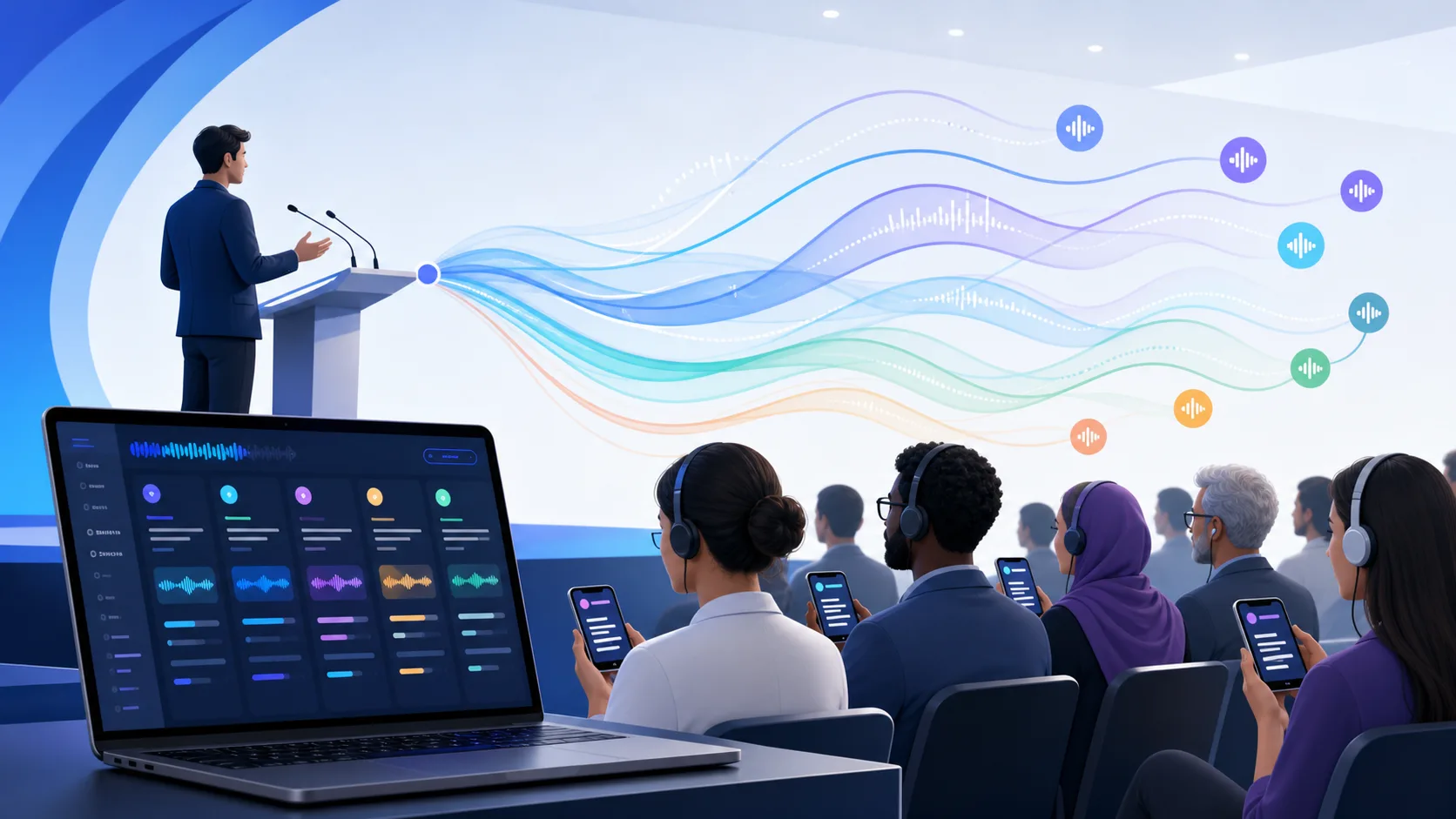
Pikka Speech vs Wordly: which live event translation platform fits your event?
Pikka Speech and Wordly both deliver AI-powered translated audio and captions for meetings and events. Their most important difference is commercial shape: Pikka exposes a granular per-event model, while Wordly packages annual hours with a broad output and integration bundle.
Written by Pikka AI Team · Reviewed September 14, 2026 · 32-minute in-depth comparison
The short verdict
Pikka Speech is the clearer choice for organizers who want to calculate one event publicly, choose audio or text per target language, scale listeners with known unit costs, or combine AI and professional interpreters inside the same room. Wordly is the stronger documented fit for organizations buying an annual pool of translation hours, automatic summaries, named platform integrations, packaged support, and published enterprise compliance signals.
This is a fit verdict, not an absolute ranking. Wordly publishes a starting figure — about $1,500 for a 10-hour package — but not the larger tier amounts, so this guide does not claim Pikka is always cheaper. It also does not declare an accuracy winner without a controlled head-to-head test.
Where Pikka Speech has the clearest advantage
Public, calculable event pricing
Pikka publishes the units needed to calculate an event: $548 per AI-audio target language, $398 per text-only target language, 25 included listeners, and defined display and seat charges.
Wordly publishes package sizes, the commercial rules, and a starting figure — about $1,500 for a 10-hour package — but not the dollar amount for the larger tiers. That makes Pikka easier to budget before a sales conversation; it does not prove Pikka is cheaper than a Wordly quote.
Buy the event instead of an annual hour package
A Pikka event pass covers a configured room for up to 14 hours. Buyers can price one event directly instead of first selecting a 10-, 25-, 50-, 100-, 250-, or 500+-hour annual package.
Wordly's 12-month package model can be an advantage for organizations running a continuing calendar of meetings, and its pricing page says buyers can also purchase by the event. Pikka's advantage is sharper for occasional or project-based events.
Separate audio and text economics
Pikka lets an organizer choose $548 AI audio per target language or a $398 text-only translation channel. The buyer pays for the delivery mode the audience needs.
Wordly advertises translation, captions, transcripts, and summaries together for one fixed price. That bundle is valuable when all outputs are required, but its public page does not present a lower text-only tier.
AI, human, and hybrid language channels
Pikka can configure each target-language channel as AI, human-only, or hybrid AI plus human coverage, allowing one room to combine delivery methods.
Wordly describes its core solution as AI translation that does not require human interpreters. Its reviewed public pages do not document an equivalent per-channel human-interpreter console, so buyers should ask Wordly rather than infer that it cannot support a partner workflow.
A broad, explicitly counted production catalog
Pikka's production catalog contains 99 source-language codes and 142 listener language or dialect codes as of this review. Those codes combine into 13,635 directed language pairs after the same-language and Chinese-dialect compatibility exclusions.
Those numbers describe catalog entries, not a promise that every possible source-target pair performs identically. Wordly uses a different measure: dozens of languages and more than 3,000 language pairs. The figures are not directly interchangeable.
Transparent audience scaling
Pikka includes 25 listeners, then publishes $2 per additional audio listener or $1 per additional text-only listener, with a $1 video surcharge for each paid listener when video is enabled.
Wordly says it customizes packages for mixed small and large events, but the reviewed pricing page does not expose a public per-attendee dollar schedule.
At-a-glance comparison
The table separates documented product facts from buyer interpretation. Pikka amounts and catalog counts come from the production configuration re-verified on September 14, 2026. Wordly statements come from Wordly's current pricing, translator-languages, and real-time translation pages, checked on the same date.
Decision factor
Pikka Speech
Wordly
Buyer interpretation
Primary buying unit
One configured event room, up to 14 hours.
Annual usage packages of 10, 25, 50, 100, 250, or 500+ hours on a 12-month term; buyers can also purchase by the event.
Pikka is simpler for a known event. Wordly may suit a recurring annual program.
Public dollar pricing
$548 AI audio per target language; $398 text only; $250 live caption display; published listener charges.
Wordly publishes a starting figure — about $1,500 for a 10-hour package — but not the larger tier amounts; those need a quote or the online store.
Pikka provides stronger pre-sales budget visibility. Compare final written totals before declaring a cost winner.
Language statement
99 source codes and 142 listener language or dialect codes in the production catalog, combining into 13,635 directed pairs.
Dozens of languages and 3,000+ language pairs.
Test exact source-target pairs. A code count and a pair count answer different questions.
Attendee access
Valid event link or QR path in a browser; listeners select an available language.
QR code or URL on phone or computer; Wordly says no attendee download or account is required.
Both support low-friction attendee entry. Test the complete join path on venue devices.
Output model
Translated audio, text-only translation, live caption displays, and downloadable session transcripts.
Translated audio, captions, transcripts, and summaries bundled; video captions optional on applicable plans.
Wordly's bundle is broader on its public page; Pikka provides more explicit delivery-mode pricing.
Human interpreter workflow
Per-language AI, human-only, or hybrid coverage controls.
Public positioning emphasizes an AI platform that does not require human interpreters.
Pikka has the documented advantage when the same room must mix professional interpreters and AI.
Integrations
Browser-first event room and shareable listener/display links; verify any platform-specific requirement.
Publicly names Zoom, Teams, Meet, WebEx, Cvent, and other integrations.
Wordly has the clearer published integration story. Pikka is strongest when a browser event room fits the production plan.
Procurement signals
Public price components and direct product access. Confirm organization-specific security requirements with Pikka.
Wordly publishes SOC 2 Type II, ISO 27001, privacy-framework, VPAT, and other enterprise signals.
For formal enterprise procurement, Wordly publishes more qualification material on the reviewed pages.
Unused capacity
The public model prices the configured event rather than banked annual hours.
Hours can be used across sessions for 12 months; Wordly says unused hours may roll over subject to sales terms.
Pikka avoids estimating an annual hour pool. Wordly offers calendar flexibility once capacity is purchased.
Support
Self-service browser workflow; define rehearsal and event-support needs before purchase.
Setup and support are included, with optional live event support and premium onboarding on applicable packages.
Wordly documents more packaged support choices. Ask both vendors to scope show-day responsibility in writing.
What is the essential difference between Pikka Speech and Wordly?
Direct answer: Pikka Speech sells a configurable multilingual event room with explicit per-event units. Wordly sells a broader AI translation and captioning service through annual hour packages. Both can serve in-person, virtual, and hybrid audiences, but they ask the buyer to plan and procure capacity differently.
A useful comparison begins by separating capability from packaging. Two platforms may both produce translated audio and captions, yet create very different planning work for an event team. With Pikka, the organizer chooses the event's target languages, selects audio or text delivery, sets listener capacity, decides whether a dedicated live caption display is needed, and sees how those inputs affect the price. The pass covers the configured room for up to 14 hours. That makes the event itself the natural budget object.
Wordly's public pricing page starts with annual usage. Starter lists 10 hours, Pro 25, Pro+ 50, Corporate 100, Corporate+ 250, and Enterprise 500 or more. Wordly says those hours can be used across sessions for up to 12 months. It bundles translation, captions, transcripts, and summaries, provides all supported languages for one fixed price, and advertises integrations plus different support levels. The public page now states a starting figure — about $1,500 for a 10-hour package — and says buyers can purchase by the event or for the entire year, but the larger tiers still require a quote or the online store.
Neither structure is inherently superior. An association running weekly webinars may prefer to buy a pool of hours once and use it throughout the year. A conference producer delivering one multilingual summit may prefer to calculate that summit without estimating annual utilization. The Pikka advantage is not simply that it has a price. The advantage is that the buyer can see how the price changes when the experience changes: spoken interpretation costs more than text-only translation, a caption display is a separate event option, and audience capacity scales through published seat units.
Pricing: what can a buyer calculate before speaking with sales?
Direct answer: Pikka provides enough public units to calculate common events. Wordly provides package sizes, rules, and a starting figure, but not the larger tier amounts on the reviewed pricing page. Therefore Pikka has the documented advantage in public budget transparency, while no honest universal price winner can be declared.
Pikka's audio event price begins with a $49 base fee and a $499 AI interpretation fee for each AI-covered target language, totaling $548 per target language. That target-language amount covers a room lasting up to 14 hours. A human-only target channel carries the base software fee without the AI interpretation fee, while hybrid coverage retains the AI fee because AI remains active on the channel. Professional interpreter service fees are not included in that software amount.
Text-only delivery has a separate all-in price of $398 per target language. It is not described as a discount layered on top of the audio price; it is a different delivery tier that does not synthesize target speech. A dedicated live caption display costs $250 per event. The first 25 listeners are included. Beyond that threshold, an audio listener costs $2, a text-only listener costs $1, and video adds $1 to each paid listener seat. Included listeners remain included when video is enabled.
These units produce checkable examples. One AI-audio target language with up to 25 listeners is $548. Five AI-audio target languages with up to 25 listeners are $2,740. One AI-audio language, a live caption display, and 100 listeners cost $948: $548 for the language, $250 for the display, and $150 for 75 additional audio listeners. One text-only target language for 100 listeners costs $473: $398 plus $75 for the additional text listeners.
Wordly's commercial logic is different. Its pricing page states that packages run for a 12-month term; hours can be spread across multiple sessions; all languages are included for one fixed price; and the package includes translation, captions, transcripts, and summaries. Wordly says it charges for actual time rather than rounding a 30-minute session up to a full hour. It also advertises volume, multi-year, nonprofit, NGO, and educational discounts. Those terms may create excellent effective economics for a frequent user.
The only public Wordly figure is the roughly $1,500 10-hour starting package; the larger tier values are not published. Without those numbers, a comparison page cannot calculate whether a bigger Wordly package costs more or less than a particular Pikka event. A third-party directory, an old PDF, or a buyer's historic quote would not solve the problem reliably because pricing changes and negotiated terms differ. The correct purchasing step is to request a current written Wordly total for the same scenario and compare it with the Pikka formula.
Per-event pricing versus annual hours
The difference between an event pass and an annual hour bank affects more than accounting. It changes forecasting risk. Suppose a company plans one eight-hour conference and may not run another multilingual event that year. A package buyer must decide which annual block to purchase, whether setup and breaks consume usage, how unused capacity is treated, and whether a future program will use the balance before its term ends. Wordly says unused hours may roll over and instructs buyers to ask a sales representative for details. That is helpful flexibility, but it remains a commercial term to confirm.
With Pikka, the same buyer scopes the room rather than a year of demand. The duration ceiling is 14 hours, so an eight-hour program fits within the event limit. The target-language charge does not multiply by eight in the published configuration. This can make approval easier for a single conference, public hearing, investor event, worship service, graduation, or training day because the purchase maps directly to the project code or event budget.
The annual model becomes more attractive when demand is persistent. Imagine a global company running weekly town halls, training sessions, and partner webinars. A shared pool can reduce repeated purchasing work. Wordly also says shared glossaries and minutes are available across users in an organization on applicable packages. Central procurement may prefer one supplier agreement, one capacity pool, and one administrative environment instead of buying event passes repeatedly.
The practical decision is therefore utilization certainty. If the event calendar is sparse, uncertain, or owned by separate project teams, Pikka's event unit limits stranded-capacity risk. If the calendar is dense and centrally managed, Wordly's term can turn a committed annual budget into operational convenience. Ask both vendors how event cancellation, postponement, overrun, concurrent sessions, and unused capacity are handled. Those details can matter more than the headline unit.
Language support: why the headline numbers are not comparable
Direct answer: Pikka lists 99 source-language codes and 142 listener language or dialect codes. Wordly advertises dozens of languages and 3,000+ language pairs. Pikka's catalog appears broader by one count, but a truthful comparison cannot convert those different measurements into a single winner.
A source-language code answers, “What can the presenter speak into the system?” A listener option answers, “What output can an attendee select?” A language-pair count answers, “How many directed source-to-target combinations does the vendor recognize?” If a platform supports 55 languages in both directions, the theoretical pair count is much larger than 55. Dialects, regional variants, output voices, recognition support, and translation compatibility further complicate the arithmetic.
Pikka's production catalog count was generated from the same definitions used by the live product, not copied from a marketing paragraph. It contains 99 source codes and 142 listener language or dialect codes on the review date. Those codes combine into 13,635 directed language pairs once same-language floor lanes and the Chinese-dialect combinations the compatibility rules do not serve are excluded. Some listener-only variants exist, and compatibility rules can filter target choices for a selected source. Therefore this guide does not say one speaker can necessarily output all 142 choices simultaneously or that every pair has the same speech quality.
Wordly states “dozens of languages / 3,000+ language pairs” and says all supported languages are included for one fixed price. That commercial simplicity is significant: a buyer adding supported languages does not, according to the public package description, pay by the language. Pikka prices target languages individually. For a program requiring many outputs, the final Wordly quote may benefit from its all-language model, even though Pikka exposes a larger explicitly counted catalog.
Language procurement should use a matrix, not a badge. List the exact source languages, target outputs, regional variants, audio versus text requirement, scripts, speaker accents, code-switching patterns, names, numbers, and domain terminology. Ask each vendor to demonstrate those combinations. If an uncommon target is supported only as text, that is different from a natural spoken output. If the event changes source language between presenters, confirm how switching works and whether the organizer must reconfigure a session.
Audience access and the in-room listener journey
Both platforms aim to remove one of the largest sources of event friction: dedicated receiver distribution. Pikka creates listener links and QR paths for the room. A listener opens the valid link in a browser and chooses from the event's available languages. Wordly says attendees scan a QR code or visit a URL on a phone or computer, select a language, and choose captions or audio. Wordly explicitly states that attendees do not need to download software or create an account.
That similarity matters. It means the buying decision should not rest on a vague “no app” claim. Event teams should test the details: how quickly the first audio arrives, whether the phone screen can lock, how Bluetooth and wired headphones behave, whether captions remain legible at large text sizes, how language switching works, and what the user sees after a temporary network interruption. Accessibility reviewers should try the path with screen readers, zoomed text, and motor constraints.
2SharePut the valid listener link or QR path in slides, signage, email, or the event app.
3ListenAttendees open the browser experience and choose an available audio or text output.
4OperateThe event team monitors language channels and can combine AI, human, or hybrid coverage.
Pikka's listener-seat model creates a specific planning question: maximum concurrent capacity. The first 25 are included, and the buyer pays for additional configured listeners. Wordly's page says buyers with a mix of small and large events should contact the company for a customized package. In both cases, use the realistic peak rather than total registration. A 2,000-person conference may have only 120 people using interpretation, while a 300-person community meeting may have 250.
QR codes also need an operational fallback. Print a short, readable URL below the code. Include the join instruction on holding slides before the speaker starts. Provide a small help point for people whose camera is disabled. Encourage headphones and consider inexpensive spares. None of those practices is vendor-specific, but they determine whether a browser-based advantage becomes a good audience experience.
Audio, captions, transcripts, and summaries
Wordly presents a broad four-product bundle on its pricing page: translation, captions, transcripts, and summaries. Its real-time translation page further describes translated audio, subtitles, transcripts, summaries, and same-language captioning. On applicable packages, the pricing table also lists transcript translation, MP3 voice transcripts for dubbing videos, and optional video captions or subtitles. Buyers who want a single annual platform for live delivery and post-event content may see substantial value in that bundle.
Pikka's public pricing is more modular. Audio AI interpretation and text-only translation are distinct target-language modes. A dedicated live caption display is an optional event line item. Pikka stores session transcript data for the organizer and supports text and subtitle-oriented downloads including TXT, JSON, SRT, and VTT at the session level. The comparison does not claim an automatic Pikka summary product, an MP3 translated voice-transcript export, or the same video-caption workflow Wordly advertises.
The right output model depends on what happens after the room closes. If communications staff must publish a summary and translated follow-up immediately, Wordly's documented summary feature should be evaluated directly. If the event team primarily needs live spoken access and caption files for an editor, Pikka's modular event scope may be sufficient. For archival or regulated records, neither a raw AI transcript nor an automatic summary should be treated as an approved record without review.
Ask vendors to demonstrate actual exports. Check timestamps, speaker handling, language labeling, Unicode, paragraph boundaries, caption line breaks, and whether corrections made during the event flow into the downloaded file. Determine who can download, how long data remains available, and what happens on room closure. A checkbox labeled “transcript” is not a complete records-management answer.
Where Pikka's human and hybrid channel design matters
Direct answer: Pikka has the clearer documented advantage when an event wants AI on some target languages and professional interpreters on others, or wants an interpreter to work alongside AI on a selected channel.
Events rarely have uniform risk. A product launch may need a professional Japanese interpreter for executive Q&A, AI audio for several informational breakout streams, and text captions for additional languages. A public meeting may use human interpretation for the legally required language while offering AI access more broadly. A medical congress may use AI for housekeeping and a specialist interpreter for clinical sessions. Treating every target language as the same delivery mode can force an unnecessary all-or-nothing decision.
Pikka's event configuration supports AI, human-only, and hybrid coverage by target language. Human-only coverage avoids the AI interpretation charge but retains the base language-channel fee; the organizer still arranges and pays the interpreter. Hybrid coverage keeps AI active while providing an interpreter path. This is a software routing capability, not a claim that an AI output becomes professionally certified because a human is present.
Wordly's reviewed pages emphasize a fully AI-powered service that does not require human interpreters or special equipment. That positioning is one of Wordly's attractions: it reduces coordination. The pages do not describe an equivalent interpreter booth or per-language human handover workflow. The careful conclusion is that Pikka documents the mixed-coverage capability more clearly. It would be unfair to turn a lack of public documentation into a categorical claim that Wordly cannot be combined with external services.
Organizer workflow, rehearsal, and show-day control
Pikka's product centers on the live room. The organizer configures target channels and audience capacity, shares listener and display links, and uses an operator interface to observe the event. The production configuration includes a 15-minute test-session allowance, giving teams a bounded path to check audio and listener behavior before the main room. A real rehearsal should still use the event microphone, mixer path, network, speaker position, and audience devices whenever possible.
Wordly says organizers can schedule a session in less than five minutes. Presenters join using a URL, and attendees join through a QR code or URL. Its pricing page includes setup and support across packages and describes premium onboarding as an optional service that can include account setup, admin training, integration assistance, glossary creation, rehearsal testing, presenter coaching, and technical support. Live event support can also be optional.
This gives Wordly a documented services advantage for a buyer who wants a vendor-defined onboarding and support package. Pikka's advantage is that the core event and cost structure is explicit and self-service oriented. Neither eliminates production responsibility. Someone must own clean speaker audio, start and stop decisions, channel monitoring, attendee instructions, escalation, and the fallback plan.
Ask for an operator responsibility matrix. Who creates sessions? Who uploads vocabulary? Who verifies every target output before doors open? Who watches channel health? Who contacts the vendor? Who tells the audience about a degraded language? Who distributes a corrected record later? A platform demo can look effortless because the demonstrator is silently performing all those roles.
Glossaries, terminology, and quality preparation
Wordly publicly lists glossaries and blocklists across its pricing packages. It also lists shared glossaries on higher packages and includes glossary creation among optional premium onboarding activities. That is a strong and clearly documented preparation story for organizations repeating the same terminology across sessions.
Pikka provides transcription context and bias terms in the live event workflow so an organizer can supply names, places, acronyms, and subject terminology. The feature is most useful when the list is concise, relevant, and tested against real speech. Feeding a system an enormous undifferentiated document is not automatically better than a curated set of high-consequence terms.
Quality preparation should include a pronunciation pass. Ask presenters to say product names, personal names, abbreviations, figures, and unusual terms in complete sentences. Test fast speech, quiet speech, overlapping audience questions, code-switching, and the microphones used on stage. Score both source captions and translated meaning. A glossary may improve recognition of a name while leaving a difficult sentence ambiguous.
Avoid accuracy theater. A clean studio monologue in a dominant language does not predict a panel in a reverberant ballroom. A single percentage can hide deletions, name errors, incorrect negation, and delayed output. The comparison found no controlled public benchmark between Pikka and Wordly, so it makes no numerical superiority claim.
Integrations and platform architecture
Wordly names Zoom, Microsoft Teams, Google Meet, WebEx, Cvent, and other platforms on its pricing page. Its product history also describes developer APIs and integrations with event management and meeting platforms. If a procurement checklist begins with a named platform, Wordly supplies more public evidence before the demo.
Pikka Speech is browser-first. The core architecture is a host room plus shareable listener and caption-display experiences. That can be simpler than a native integration when the production team can place a link or QR code in the event journey. It can also be less suitable when the requirement is to inject a translated channel directly into a specific webinar platform, synchronize identities with an enterprise tenant, or embed controls inside an event-management console.
“Works with” is ambiguous. It may mean a native marketplace application, a meeting bot, an audio-device bridge, a browser link shared in chat, an iframe, an API, or simply running alongside the platform. Require the vendor to show the exact topology. If remote attendees must listen inside the same video player, a second browser tab may not meet the requirement. If QR access is acceptable, a separate listener page may be easier to deploy across many meeting platforms.
Pikka should be favored when the event team values a dedicated multilingual room, explicit channel control, and an audience link it can distribute anywhere. Wordly should receive extra weight when a named integration on its public list matches a mandatory enterprise workflow. Test authentication, mobile behavior, audio routing, recording consent, and failure recovery instead of relying on an integration logo.
Security, privacy, compliance, and procurement
Wordly publishes a visible set of enterprise trust signals on the reviewed pages, including SOC 2 Type II and ISO 27001, plus references to privacy frameworks, GDPR, HIPAA, CCPA, and an available VPAT. A logo or standard name is not the full diligence package, but it gives enterprise buyers concrete documents to request and validate.
This comparison does not assign the same certifications to Pikka Speech. It would be inaccurate to imply equivalence without current certificates and scope statements. Pikka buyers should ask for the data-flow diagram, subprocessors, hosting regions, encryption details, access-control model, incident process, retention behavior, deletion path, and contractual commitments relevant to their event. Sensitive content may also require limits on transcript storage and operator access.
Security fit depends on the event. A public conference keynote and a confidential board meeting should not use identical assumptions. Determine whether attendee identity is necessary, whether a shareable link is acceptable, how links are revoked, who can operate the host room, and what records persist. For regulated data, involve privacy, security, legal, and accessibility teams before purchasing either platform.
Wordly has the public-documentation advantage here. Pikka retains a commercial-transparency and mixed-channel advantage, but those benefits do not replace security evidence. A balanced shortlist can score procurement readiness separately from event workflow so a feature-rich platform does not pass a mandatory control by implication.
Which platform is better for common event scenarios?
One multilingual conference or summit
Pikka is usually easier to scope when the organizer knows the target languages and expected listener count and wants a single event pass. The transparent formula supports rapid budget revisions. Wordly remains a credible option, especially if the quote includes support, summaries, or an integration the event already uses. Compare the written total and the show-day responsibility, not only the subscription label.
A year-round webinar and meeting program
Wordly's annual hours, shared organizational features, summaries, and named integrations may be a natural fit. Its packages are designed around recurring use. Pikka can still serve repeated events, but the buyer should assess the administrative overhead of event-by-event purchasing and whether a custom commercial arrangement is available.
An event mixing AI and professional interpreters
Pikka has the clearer advantage because its channel model explicitly supports AI, human-only, and hybrid coverage by target language. Require an end-to-end rehearsal with interpreter authentication, handover, audio monitoring, and the audience path. Wordly buyers should ask how external interpreters would be incorporated because the reviewed pages focus on an AI-only service model.
A large multilingual audience with many target languages
Do not assume Pikka wins because its catalog count is larger. Pikka adds price per target language and paid listener beyond 25. Wordly advertises all supported languages for one fixed package price and customizes for audience mixes. A Wordly quote could be commercially attractive at high language counts. Test exact languages and compare capacity, concurrency, support, and total scope.
A text-first accessibility program
Pikka's $398 text-only target-language tier and $1 paid text-listener unit offer a clear, calculable path when synthesized audio is unnecessary. Wordly includes captions in its bundle and may add value through transcripts and summaries. Compare display requirements, caption formatting, accessibility review, and post-event output.
A procurement-heavy global enterprise
Wordly publishes more integrations, support packaging, organizational features, and compliance signals. It may progress through vendor qualification more easily. Pikka can still win on the event workflow, especially when mixed interpreter modes or transparent project costing are decisive, but it should be assessed against the same mandatory security and legal controls.
How to compare quotes without creating a false result
Create one scope sheet and send it to both vendors. Include event date, total operating hours, rehearsal time, number of concurrent rooms, source languages, target languages, audio and caption needs, attendee peak, video, exports, summaries, glossary preparation, integrations, operator staffing, live support, retention, security, and accessibility requirements. Ask each vendor to mark included, optional, unsupported, and customer-provided items.
Normalize time. Pikka's target-language price covers a room up to 14 hours, while Wordly meters purchased annual hours and says it does not round a 30-minute session upward. Clarify whether Wordly usage is counted per concurrent session, per source channel, per language, or by another rule in the actual quote. Clarify how setup, breaks, overruns, and rehearsal are treated by both vendors.
Normalize outputs. If Wordly includes summaries and Pikka does not, do not erase that value merely to compare translation. If Pikka provides a lower-cost text-only option and the event does not need audio, do not quote the audio tier. If professional interpreters are required, include staffing costs with both platforms and distinguish software fees from language-service fees.
Normalize support and risk. A quote with a live technician is not equivalent to self-service software. A quote backed by a required enterprise agreement is not equivalent to an online checkout. Add internal labor, device rental, network upgrades, rehearsal, and accessibility review. The lowest line-item price can be the higher total project cost if it transfers more responsibility to the event team.
Testing plan: a fair proof of concept
Use the same audio path. Feed both products the same microphone, mixer, room acoustics, and representative speakers.
Test exact languages. Include the source-target pairs, dialects, and scripts the event will actually use.
Prepare the same terminology. Give each vendor an equivalent list of names, acronyms, places, and domain terms using its supported preparation workflow.
Measure meaningful errors. Track omissions, additions, incorrect names and numbers, negation errors, terminology, meaning, timing, and spoken-output intelligibility.
Test attendee friction. Time QR entry, language selection, first audio, caption readability, headphone routing, reconnection, and help requests on both iOS and Android.
Test operations. Change a speaker, switch or add a language where permitted, simulate a network interruption, end a session, and retrieve the promised outputs.
Include stakeholders. Ask native speakers, interpreters, accessibility reviewers, AV operators, information security, and event owners to score the dimensions they understand.
A valid proof of concept does not need a laboratory, but it needs a written rubric. Record the product configuration and date because models and features change. Do not tune one platform extensively and test the other with defaults. Do not accept a vendor's self-selected demo language as evidence for your most difficult pair.
Questions to put in the request for proposal
Ask each vendor to answer in writing. Which exact source and target combinations are supported for audio and text? How is usage counted? What happens when the session reaches its purchased duration or audience capacity? How many rooms can run concurrently? What browser, operating system, and network requirements apply? What attendee data is collected? Which administrators can retrieve transcripts? What deletion and retention controls exist?
Then ask operational questions. Can a presenter change source language mid-session? Can the operator add a target after the event begins? Can a human interpreter take or share a channel? How are glossaries scoped and updated? How does the platform report degraded output? What is the support response path during a live show? Does vendor support observe or access event content? What evidence is available after an incident?
Finally, ask commercial questions. Are taxes, onboarding, support, overages, integrations, and premium voices included? Does an hour run once per session or once per output? Can unused time roll over and under what conditions? Is the order renewable automatically? What happens if the event moves? Can the buyer reduce scope? The answer should match the quote, order form, and service terms, not only the sales presentation.
Total cost of ownership beyond the vendor invoice
Software price is only one line in multilingual event delivery. Count AV time for audio routing, network design, QR slides, signage, rehearsal, device testing, monitoring, and audience support. Add professional interpreters where required, terminology preparation, transcript review, caption correction, and project management. A browser workflow can avoid receiver rental, but an event may still buy spare headphones or dedicated connectivity.
Annual packaging has internal costs too. Someone must forecast hours, allocate the pool, administer users, monitor usage, renew terms, and prevent surprise overages. Event passes require repeated configuration and purchasing. Neither overhead is automatically large, but it should be assigned to the team that will actually perform it.
Evaluate the cost of missing capabilities. If a Wordly integration avoids custom production work, that has value. If Pikka's hybrid interpreter path prevents the event from operating a second system, that has value. If a summary saves communications time, count it. If a text-only Pikka tier avoids paying for synthesized audio no one needs, count that too. A fair total-cost model values useful differences rather than forcing every feature to zero.
Known limitations and claims this guide does not make
First, it does not claim Pikka is always less expensive. Pikka's prices are calculable; Wordly's larger-tier dollar prices are unavailable on the reviewed page. A negotiated Wordly quote may be lower or higher for a specific scope. Second, it does not claim Pikka supports “more languages” in a directly comparable sense because catalog codes and language pairs are different measures.
Third, it does not declare an accuracy or latency winner. Network, language, audio, speaker, terminology, output mode, and scoring method affect results. Fourth, it does not say Wordly lacks human-interpreter compatibility; it says the reviewed public pages do not document the per-channel human and hybrid controls that Pikka exposes. Fifth, it does not equate a transcript with a legally approved record.
Finally, this page is written by Pikka AI and is therefore not an independent review. Its safeguards are visible sourcing, specific dates, attributed competitor statements, publication of Pikka's own pricing assumptions, explicit unknowns, and a recommendation to run the same proof of concept. Buyers should read the linked Wordly sources and obtain current terms directly.
Final recommendation
Direct answer: Shortlist Pikka Speech first when the purchase is event-specific, transparent pricing is important, text and audio should be priced separately, audience scaling must be calculable, or professional interpreters need to share the room with AI. Shortlist Wordly first when annual usage, bundled summaries, named integrations, packaged support, and published enterprise trust signals dominate the requirement.
If both profiles apply, run the same event through both. Use Pikka's published formula as one commercial baseline and request a Wordly quote that itemizes the corresponding term, hours, concurrent sessions, attendees, outputs, onboarding, and support. Then compare operational labor and risk alongside vendor charges.
Pikka's most defensible sales case is not “we are better at everything.” It is narrower and stronger: an organizer can see the event units, buy the delivery mode the audience needs, combine AI and human coverage by language, and distribute the experience through browser listener paths. That combination is meaningfully different from an annual all-output package and may be exactly what an event-based buyer needs.
Continue with the Pikka Speech vs AI-Media LEXI comparison if your shortlist also includes broadcast captioning hardware or production display systems. If you are not switching vendors but looking for a tested fallback while Wordly remains primary, read the Wordly backup plan. For Pikka's product overview and current public pricing explanation, visit Pikka Speech. For Wordly's own package details, read its official pricing page .
Frequently asked questions
Is Pikka Speech cheaper than Wordly?
The reviewed public evidence cannot prove a universal price winner because Wordly publishes only a starting figure — about $1,500 for a 10-hour package — and not the larger tier amounts. Pikka can be calculated publicly: an AI-audio target language is $548 for an event of up to 14 hours, 25 listeners are included, and additional components have published charges. Obtain a Wordly quote for the same languages, hours, attendees, outputs, support, and term before comparing totals.
Which is better for a one-off conference or summit?
Pikka Speech is usually the simpler documented fit when you want to budget one conference directly: its public model prices a configured event room, with separate units for audio versus text targets and for listener scaling. Wordly's public model is an annual hour package, which can be a stronger fit when an organization expects recurring meetings or events over a 12-month term and values a bundled output and integration package. Validate the actual join flow, languages, support expectations, and written totals before deciding.
What is the strongest Pikka Speech advantage over Wordly?
The strongest documented advantage is commercial granularity: transparent per-event prices, separate audio and text tiers, published listener scaling, and per-language AI, human, or hybrid coverage. This is most valuable to organizers who know the shape of an event but do not want to begin with an annual hour commitment.
What is Wordly's strongest advantage over Pikka Speech?
Wordly presents a mature annual platform package with translated audio, captions, transcripts, summaries, named meeting and event integrations, optional live support, and a more visible enterprise compliance posture. Organizations with a recurring program and formal procurement requirements may value that breadth.
Do attendees need an app for Pikka Speech or Wordly?
Both products document browser-style access. Pikka listeners use a valid event link or QR path. Wordly states that attendees scan a QR code or visit a URL on a phone or computer and do not need a download or account. Event teams should still test captive Wi-Fi, camera permissions, headphone routing, and accessibility on the actual venue devices.
Which supports more languages, Pikka Speech or Wordly?
The published figures use different units and cannot be ranked honestly. Pikka's production catalog contains 99 source-language codes and 142 listener language or dialect codes, combining into 13,635 directed language pairs after compatibility exclusions. Wordly advertises dozens of languages and more than 3,000 language pairs. Check the exact source language, target language, voice or caption requirement, and domain vocabulary instead of comparing the headline numbers.
Can Pikka Speech use human interpreters?
Yes. Pikka supports AI, human-only, and hybrid AI-plus-human coverage on individual target-language channels. That makes it possible to reserve professional interpreters for selected languages or high-risk sessions while using AI elsewhere. Interpreter staffing and professional service fees are separate from the software's published event pricing.
Does Wordly include transcripts and summaries?
Wordly's pricing page says translation, captions, transcripts, and summaries are included together in its offering, subject to package details. Pikka provides downloadable session transcripts but this comparison does not claim an equivalent automatic summary feature for Pikka Speech.
Can I buy Pikka Speech for one event?
Pikka's published model is an event pass for a configured room of up to 14 hours. The price depends on target languages, delivery mode, optional live caption display, listener count, and video on paid listener seats. That structure is designed to make a single event calculable.
Does Wordly require an annual contract?
Wordly states that its packages have a 12-month term and that purchased hours can be used across multiple sessions during that period; its pricing page also says buyers can purchase by the event or for the entire year, and provides an online purchase path. Buyers should confirm the exact order form, renewal, rollover, and cancellation terms because a package term is not necessarily identical to every customer's contract.
Which is better for Zoom, Teams, Meet, WebEx, or Cvent?
Wordly explicitly names those platforms on its pricing page, so it has the clearer documented integration advantage. Pikka Speech is a browser-first event room with shareable listener and display links. If a native integration, bot, embedded widget, or platform authentication is mandatory, require a live demonstration of that exact path.
Which is more accurate?
No accuracy winner is declared. This review found no independent, controlled, current head-to-head benchmark using the same audio, languages, vocabulary, network, scoring method, and product configuration. Run a representative test and score names, numbers, terminology, omissions, meaning, caption timing, and translated audio—not only raw word accuracy.
Can either tool replace professional interpreters for every event?
No responsible comparison should make that promise. AI can expand access and reduce logistical load, but legal, medical, diplomatic, safety-critical, emotionally sensitive, and highly nuanced contexts may require qualified human interpreters. Pikka's hybrid channel design is useful when an organizer wants both methods in one event plan.
Sources and verification method
This comparison uses first-party product pages and Pikka Speech's production configuration. Competitor claims are attributed to the competitor. Where public information does not answer a question, the page says so instead of filling the gap with an assumption.
Publisher: Pikka AI. Checked September 14, 2026. Browser event rooms, host and listener workflows, language selection, caption screens, and transcript delivery.
Publisher: Pikka AI. Checked September 14, 2026. Public product positioning, event use cases, audience access, and the current published pricing explanation.
Publisher: Wordly. Checked September 14, 2026. Annual hour packages (10 to 500+ hours) on a 12-month term, the published "starts at about $1,500 for a 10-hour package" figure, the statement that buyers can purchase by the event or for the entire year, the statement that more hours can be added at any time during a term, rollover wording that defers to a sales rep, the "dozens of languages / 3,000+ language pairs" table row, bundled products, integrations, discounts, the 5-10 minute new-account activation estimate with the recommended Customer Success onboarding session, the optional premium onboarding and support tier, the personalized 30-minute demo, the published security and privacy certifications (SOC 2 Type II, ISO 27001, DPF, GDPR, HIPAA, CCPA, VPAT available), and the quote or online-purchase path.
Publisher: Wordly. Checked September 14, 2026. Attendee QR or URL access, no attendee download or account, output formats, event formats, and Wordly-reported adoption milestones.
Publisher: Wordly. Checked September 14, 2026. The published speaker-language list (60 entries) and attendee-language list (67 entries) counted on the review date, the "thousands of language pair options" wording, automatic language selection, the one-fixed-price all-languages statement, the few-minutes session-setup wording, and the post-purchase onboarding-session mention.
No vendor supplied a private benchmark or paid for placement. Product pages change, so buyers should confirm requirements and final commercial terms with each vendor before purchase.
Price your actual event, not a generic bundle
Use your target-language count, delivery mode, caption-display need, and audience size to decide whether Pikka Speech fits. Then test the listener journey with the same devices your audience will use.