Pikka Speech vs KUDO: which live speech translation setup fits your event?
Pikka Speech and KUDO both help event teams deliver live multilingual access. The key difference is commercial and operational shape: Pikka sells a publicly priced event room, while KUDO sells a language layer for online meeting platforms, with options that include interpreter sourcing and embedded integrations.
Written by Pikka AI Team · Reviewed August 23, 2026 · 22-minute comparison
The short verdict
Choose Pikka Speech when you want transparent per-event pricing, separate audio vs text choices per target language, QR/browser listener access for in-room audiences, and a plan that can combine AI and interpreters you already have. Choose KUDO when you need vendor-supported interpreter sourcing (including sign language), participants must access language inside a specific online meeting platform (not a separate listener experience), or you need the integration and online-meeting capacity signals KUDO publishes.
This is a buyer-fit verdict, not an accuracy ranking. The KUDO pages reviewed for this guide do not display dollar prices, so this page does not claim that Pikka is cheaper than a KUDO quote. Run a representative test and compare written totals for the same scope before deciding.
Where Pikka Speech has the clearest advantage
Published, spreadsheet-ready event units
Pikka publishes the components needed to price a typical event: $548 per AI-audio target language, $448 per text-only target language, a $250 caption display option, 25 included listeners, and published seat charges above that.
KUDO explains plan structure (Marketplace, Pay As You Go, Annual Plan) and publishes multiple capability numbers, but its reviewed plans page does not display a dollar amount for a plan or for a meeting. So Pikka is easier to budget publicly before contacting sales; that does not prove Pikka is always cheaper than a KUDO quote.
Event-shaped buying unit (up to 16 hours)
A Pikka Speech event pass covers one configured room for up to 16 hours. For one-off or project-coded events, that maps directly to how budgets are approved.
KUDO’s Annual Plan is described as starting from 50 hours per year, and its Pay As You Go structure is designed for recurring or ad-hoc use. If you have a dense calendar and can reliably consume an hour pool, hour-based packaging can be more convenient than buying per event.
Separate audio vs text economics
Pikka distinguishes synthesized audio from text-only translation with different published target-language prices. That makes it easier to design accessibility scope without paying for speech output that a text-first audience may not need.
KUDO’s pages emphasize “audio and captions” together and offer a custom glossary upload for its AI Speech Translator. Buyers should confirm whether KUDO offers a priced text-only tier or whether captions and audio are packaged together commercially.
Audience entry built around a QR/browser listener path
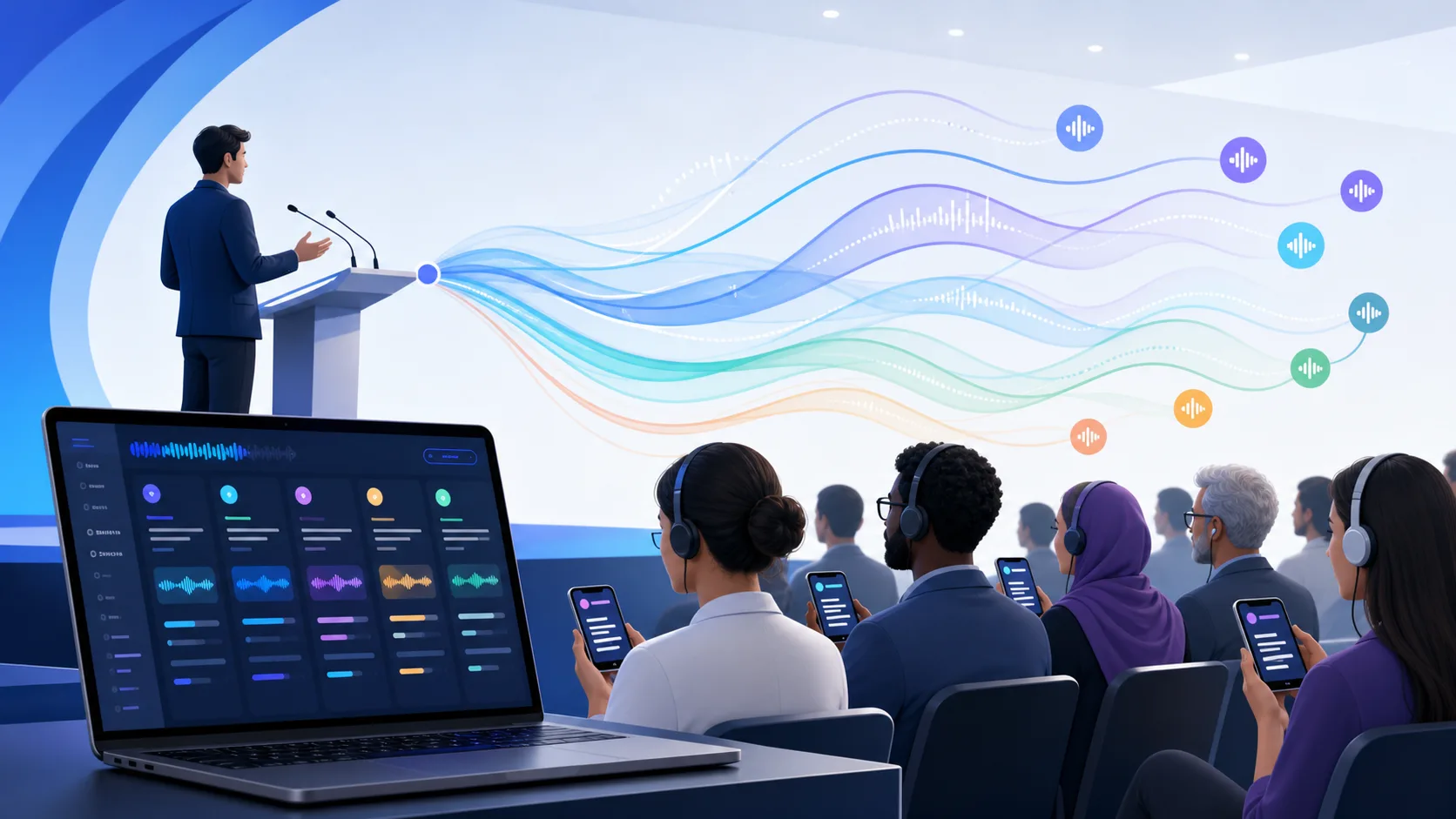
Pikka’s core flow is an event room plus a listener link or QR code that attendees open in their browser to pick a language channel, without requiring an app install.
KUDO also states that it is browser-based and offers mobile apps. Its differentiator is the ability to embed a language selector widget into other meeting and event platforms, including Microsoft Teams native integration. If participants must stay inside a specific meeting UI, KUDO’s embedded approach can be a better fit.
At-a-glance comparison
The table separates documented product facts from buyer interpretation. Pikka amounts come from the live Pikka configuration referenced on /speech. KUDO statements are attributed to the KUDO plans/features and live speech translation pages, linked below.
Decision factor
Pikka Speech
KUDO
Buyer interpretation
Primary buying unit
One configured event room, up to 16 hours.
Pay-as-you-go and annual plans; the Annual Plan is described as starting from 50 hours per year.
Pikka is simpler when procurement wants to buy one known event. KUDO can fit better when an organization expects recurring multilingual meetings and wants an hour-based plan.
Public dollar pricing
$548 AI audio per target language; $448 text-only; $250 caption display; published listener seat charges.
Plan structure and capability numbers are public, but the reviewed plans page does not display a dollar amount per plan or per event.
Pikka has stronger pre-sales budget clarity. Compare the final written totals for the same scope before declaring a cost winner.
Human interpreter sourcing
Supports AI, human-only, and hybrid channels, but organizers source and pay professional interpreters separately.
Publishes an interpreter marketplace model and says it works with a network of professional interpreters, covering spoken and sign languages.
KUDO is a stronger fit when you want interpreters and technology from one supplier. Pikka fits when you already have interpreters and need software routing plus a published event model.
Sign-language requirement
No sign-language interpreter sourcing is provided by Pikka Speech.
Publishes coverage of spoken and sign languages for human interpretation services.
If signed interpretation is required, KUDO (or a specialist provider) is the safer shortlist starting point. Do not treat AI audio as a substitute.
AI vs human communication model
AI audio and text channels for the configured targets; hybrid designs can keep humans where consequence is high.
Describes KUDO AI Speech Translator for one-way communication and professional interpreters for one-way and interactive communication.
KUDO is explicit that interactive decision-making belongs with human interpreters. Pikka buyers should make the same conservative distinction and document which sessions stay human-led.
Integrations and embedded access
Browser-first event room with shareable listener and caption-display links; validate any platform-specific requirement.
Publishes Microsoft Teams native integration and describes embedded widget options for other meeting and event platforms.
KUDO is the better documented fit when participants must access language inside a specific platform UI. Pikka is strongest when a browser listener path fits the event plan.
Published language statements
99 source-language codes and 142 listener language/dialect codes in the production catalog, combining into 13,635 directed pairs (catalog counts).
Publishes 200 spoken and sign languages for human interpretation and 70+ languages for AI speech translation, plus a statement that up to 32 languages can be supported per meeting.
Different units. Confirm your exact source-target pairs and whether the output is audio, captions, or both rather than comparing headline numbers.
Capacity statements
Includes 25 listeners and publishes seat pricing above that; capacity is configured per event room.
Publishes “up to 3,000 users per language, per meeting or event” and “up to 32 languages per meeting.”
KUDO publishes clearer maximums for a single multilingual meeting. For Pikka, use your event’s realistic peak and price it from the published seat units.
Glossary support (AI)
Supports event preparation via terminology inputs in the room workflow; validate the exact current controls in the app.
Publishes “custom glossary upload” for the KUDO AI Speech Translator.
Both require disciplined, tested terminology. The real differentiator is operational: who owns the term list, when it is frozen, and how changes are communicated on show day.
What is the essential difference between Pikka Speech and KUDO?
Direct answer: Pikka Speech is a browser-first event room that an organizer can price from published units. KUDO is a language layer designed to run on (or embed into) online meeting and event platforms, with options that include sourcing professional interpreters and supporting sign languages.
Buyers often compare these products because both can deliver live translated audio and captions. The more important difference is the operational contract you are signing with your event team.
With Pikka, you configure the room, share a listener link or QR code, and your audience joins in a browser and chooses a language. The commercial model is event-shaped and public: the most important units are visible on /speech. For example, one AI-audio target language with up to 25 listeners is $548.
With KUDO, the platform emphasizes embedding into an existing meeting or event workflow (including Microsoft Teams native integration and widget options for other platforms), and it sells human interpretation and AI speech translation as part of a language-access layer. It also publishes interpreter marketplace positioning and language claims that include sign languages. That shape is often the better answer for interactive online meetings where participants must stay inside the meeting UI.
Pricing and procurement: what can you know before a sales call?
Direct answer: Pikka’s per-event units are published. KUDO’s reviewed pages explain plan structure but do not show a dollar price. So Pikka has the advantage in pre-sales budget transparency, while KUDO requires a quote to compare totals honestly.
Pikka’s published units make it possible to calculate common scenarios without guessing. You can price audio per target language, choose a $448 text-only tier when audio is unnecessary, decide whether to add a $250 caption display, and estimate seats above the included listener count at published rates.
KUDO’s reviewed plans page describes Marketplace, Pay As You Go, and an Annual Plan “from 50 hours per year,” and it publishes capability statements such as “up to 32 languages per meeting” and “up to 3,000 users per language.” Those signals can be valuable for planning, but they do not answer “what will this event cost?” without a quote.
Audience access: QR/browser listeners vs embedded in-platform access
For in-room events, Pikka’s default join path is straightforward: project a QR code, attendees scan, choose a language, and listen on their own headphones in the browser. That can avoid distributing proprietary receivers and can be easy to explain on slides and signage.
KUDO’s published positioning emphasizes staying inside the meeting or event platform where possible: a native Microsoft Teams integration, and embedded widget approaches for other platforms. For an online town hall, the ability to keep participants inside one UI can reduce friction.
Two common production flows
1Browser roomConfigure event → share QR/link → attendees join in browser → select language → listen/captions.
2Embedded layerRun the meeting on an existing platform → embed language selector → participants activate audio/captions within the meeting context.
3Human coverageAssign interpreters where consequence is high; use AI only where it passes rehearsal and risk review.
4OperateMonitor source audio, channel output, and audience issues; keep an explicit fallback plan.
The join experience should be tested, not assumed. Evaluate phone headphone behavior, reconnection after a temporary network drop, caption legibility at large text sizes, and the help workflow for attendees who cannot connect. The best product on paper can fail if the room’s network or device mix was never tested.
Human interpreters and the “don’t replace professionals” line
Direct answer: Neither product should be marketed as a universal replacement for professional interpreters. KUDO explicitly recommends professional interpreters for decision-making and interactive communication, and Pikka supports human-only and hybrid channels while requiring organizers to engage interpreters separately.
The responsible decision is session-specific. Keep humans for medical, legal, safety-critical, rights-affecting, diplomatic, crisis, and similarly high-consequence communication, and for any language pair that fails rehearsal. Use AI only where you can tolerate mistakes and where you have an operator plan to detect and correct failures.
If your requirement includes signed interpretation, do not treat captions or AI speech as an equivalent substitute. Use a platform and staffing plan that explicitly supports signed interpreting, and test camera framing, pinned video, sightlines, and the accessibility plan with stakeholders.
Language support: the right way to compare “99/142” and “200/70+”
Pikka publishes a production catalog count: 99 source-language codes and 142 listener language or dialect codes, combining into 13,635 directed language pairs after compatibility exclusions. KUDO publishes separate claims for human and AI: “200 spoken and sign languages” for human interpretation and “70+ languages” for AI speech translation, plus a statement that up to 32 languages can be supported in one meeting.
These are not directly comparable units. Your event needs an exact matrix: what the speakers will speak (source), what the audience needs (targets), whether the output is audio or captions, and whether the content requires humans. Build that matrix and test it; don’t choose based on a headline number.
Recommendation and next steps
Direct answer: Shortlist Pikka Speech when you want an event room with public per-event pricing and a QR/browser listener flow. Shortlist KUDO when you need embedded meeting-platform access, vendor-supported interpreter sourcing (including sign language), or KUDO’s published online-meeting capacity assumptions.
Next, run an aligned rehearsal. Use the same audio, the same speakers, and the same glossary list. If you want a practical runbook, start with the 15-minute rehearsal checklist and treat the result as evidence: what passed, what failed, and what must remain human-led.
Reviewed August 23, 2026. Pikka pricing units are taken from the Pikka Speech configuration described on /speech. KUDO statements are attributed to the linked KUDO sources.
Frequently asked questions
Is Pikka Speech cheaper than KUDO?
The reviewed public evidence cannot prove a universal price winner, because KUDO’s plans page describes structure and capabilities but does not display a dollar amount per plan or per event. Pikka can be calculated publicly: an AI-audio target language is $548 for an event room of up to 16 hours, text-only is $448 per target language, 25 listeners are included, and additional seats have published charges. Request a KUDO quote for the same languages, hours, meeting platform, attendee scale, interpretation staffing, and support before comparing totals.
When is KUDO the better choice?
KUDO is the better documented fit when you need the vendor to help source professional interpreters (including sign language), when participants must access language inside a specific meeting platform UI (e.g. Microsoft Teams native integration or embedded widgets), or when you need the capacity and integration signals KUDO publishes for online meetings.
When is Pikka Speech the better choice?
Pikka Speech is usually the stronger fit when you want to budget one specific event publicly, choose audio or text per target language, scale listener seats with published unit costs, and run an in-room audience join flow via QR/link in the browser. It also fits well when you already have interpreters and want to combine human-only channels with AI channels in one event plan.
Do either of these replace professional interpreters?
No. KUDO explicitly positions professional interpreters for decision-making and interactive communication, and Pikka explicitly supports human-only and hybrid channels while stating that interpreter professional fees are separate. High-consequence communication (medical, legal, safety-critical, diplomatic, rights-affecting, crisis) may require qualified interpreters regardless of the software platform.
Which supports more languages?
The headline figures use different units. Pikka publishes catalog counts (99 source codes and 142 listener language or dialect options, combining into 13,635 directed pairs after compatibility exclusions). KUDO publishes a human-interpretation claim of 200 spoken and sign languages and an AI claim of 70+ languages, plus a statement that up to 32 languages can be supported per meeting. Test the exact source-target pairs, dialects, and output mode your event needs rather than comparing the headline numbers.
How should we evaluate quality fairly?
Use the same audio, speakers, languages, and terminology. Score meaningful failures (names, numbers, negation, omissions, domain terms, caption timing, intelligibility) and include stakeholder review (native speakers, interpreters, accessibility reviewers, and AV operators). Do not accept a vendor-selected demo as evidence for your hardest pair.
Sources and verification method
This comparison uses first-party product pages and Pikka Speech's production configuration. Competitor claims are attributed to the competitor. Where public information does not answer a question, the page says so instead of filling the gap with an assumption.
Publisher: Pikka AI. Checked September 14, 2026. Browser event rooms, host and listener workflows, language selection, caption screens, and transcript delivery.
Publisher: Pikka AI. Checked September 14, 2026. Public product positioning, event use cases, audience access, and the current published pricing explanation.
Publisher: KUDO. Checked August 23, 2026. Plan structure, the published language claims for human interpretation and AI speech translation, glossary upload wording, meeting capacity statements, and listed compliance signals.
Publisher: KUDO. Checked August 23, 2026. Integration positioning (including Microsoft Teams), the language and capacity statements, and KUDO's description of human versus AI translation use cases.
No vendor supplied a private benchmark or paid for placement. Product pages change, so buyers should confirm requirements and final commercial terms with each vendor before purchase.
Price your actual event, not a generic bundle
Use your target-language count, delivery mode, caption-display need, and audience size to decide whether Pikka Speech fits. Then test the listener journey with the same devices your audience will use.